

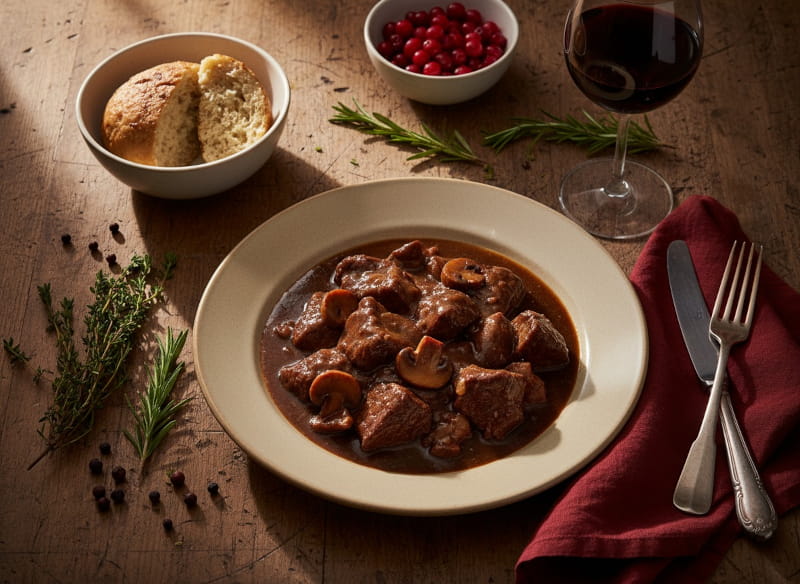
When the forest comes to the plate – dark meat, deep flavors, red Moselle
Combining wine and food with wild boar goulash from the Eifel means having the courage to try the red Moselle. Because the Moselle is not only the home of Riesling. In the forests of the Eifel, where wild boar roam through oak groves and porcini mushrooms shoot up from the ground after the first autumn rain, a dish is created that smells of dark braised meat, forest soil and game spices – a dish that calls for red wine. And the Middle Moselle provides it: an elegant Pinot Noir that shows that this region is capable of far more than just white wine.
Wild boar goulash from the Eifel region is the essence of the autumnal hunting dish: shoulder or leg, slowly braised in a dark broth of red wine, juniper berries and root vegetables, enriched with porcini mushrooms and wild mushrooms, which add their umami depth to the sauce. The result is a goulash with a sauce so dark and deep that it is hard to believe that no more drippings can dissolve in it – and yet with every further sip of Pinot Noir, a new layer is revealed.
Ideal wine accompaniment: Mosel Spätburgunder QbA dry (Middle Mosel, Germany)
A delicate cherry fruit, strawberry notes, a hint of wild berries and an underlying earthiness that comes from the slate soil of the Middle Moselle and makes the wine unmistakably Moselle – this Pinot Noir is not a copy of Burgundy, but an independent statement. The cool Middle Moselle nights give the wine a freshness that is never heavy despite its red fruit and fine tannins. And it is precisely this lightness that is the secret of the pairing with the wild boar goulash.
Wild boar is naturally stronger and spicier than beef or pork – its meat has more character of its own, a slight gaminess that calls for a wine with personality, but not one that overpowers the meat. The fine tannin of the Mosel Pinot Noir opens up the dark meat, draws out the spice of the juniper berries and combines with the mushrooms to create an earthy, mineral aroma that lingers on the palate for a long time. The cool acidity of the wine cuts through the richness of the braised jus with precision and keeps every bite fresh. A wine that honors the wild boar without overwhelming it.
Further wine recommendations for this dish
Pfalz Pinot Noir QbA dry (Pfalz, Germany)
Stronger, fuller-bodied and with more tannin than its Moselle counterpart – Pinot Noir from the Palatinate is the wine for anyone who wants more red wine substance in their glass with wild boar goulash. The warmer Palatinate climate produces a Pinot Noir that is darker in fruit, has more body and a pronounced tannin – just the thing when the goulash has been braised for a long time and the sauce has become almost syrupy deep due to reduction. In combination with porcini mushrooms, the Pfalz Pinot Noir develops a depth that is surprising: the dark plum fruit of the wine combines with the umami of the mushrooms to create a dark, warm aroma that carries through a long, wintery evening. Pinot Noir wines from Palatinate wineries such as Rings and Philipp Kuhn show why the Palatinate is regarded as Germany’s leading red wine region.
Pinot Noir Bourgogne AOC (Burgundy, France)
Cool, earthy, silky in texture – Bourgogne Pinot Noir is the most international and elegant alternative for wild boar goulash. Where the Mosel Pinot Noir offers regional authenticity, the Bourgogne brings cosmopolitan finesse. Its aroma spectrum ranges from cherry and forest floor to leather and a hint of clove – all notes that create a harmonious resonance with the forest character of the wild boar meat and the porcini mushrooms. The typical Burgundy coolness prevents the pairing from slipping into heavy opulence. If you are cooking the wild boar goulash for a special occasion and are prepared to invest in the wine, go for the Bourgogne AOC – and understand why this combination has been considered a classic for centuries.
Rheingau Spätburgunder QbA dry (Rheingau, Germany)
The Rheingau Pinot Noir finds its own place between the Mosel and Burgundy: more fullness than the Mosel Pinot Noir, slightly less power than the Palatinate, with an accessibility and elegance that makes it perhaps the most balanced German Pinot Noir. In the best vineyards of Assmannshausen and Lorch, where the Rheingau cultivates its red wines, Pinot Noirs with a fine herbal spiciness and a long, silky finish are produced. It goes particularly well with wild boar goulash when the sauce is flavored with thyme, rosemary and juniper berries – the herbal notes of the wine and those of the sauce combine to create an aromatic arc that lingers on the palate for a long time. For wine connoisseurs who like to compare, a Rheingau Pinot Noir alongside a Mosel Pinot Noir is an enlightening parallel tasting at a game goulash evening.
Côtes du Rhône AOC (Rhône Valley, France)
Grenache, Syrah and Mourvèdre from the southern Rhône valley – the Côtes du Rhône is the most powerful and sun-ripened alternative on this list, and it works with wild boar goulash in a completely different way to the Burgundy variations. Where Pinot Noir convinces with elegance and lightness, the Côtes du Rhône focuses on warmth, depth and a spicy richness that literally embraces the stewed jus of the goulash. The leather and pepper notes of the Grenache-Syrah blend combine with the wild mushrooms to create a dark, intense aromatic profile that saturates the palate. A choice for anyone who would rather have a strong southern French wine in their glass with wild boar stew than an elegant German Pinot.
All other recipes and wine recommendations from the Moselle region can be found in the Moselle wine region category.
The recipe:
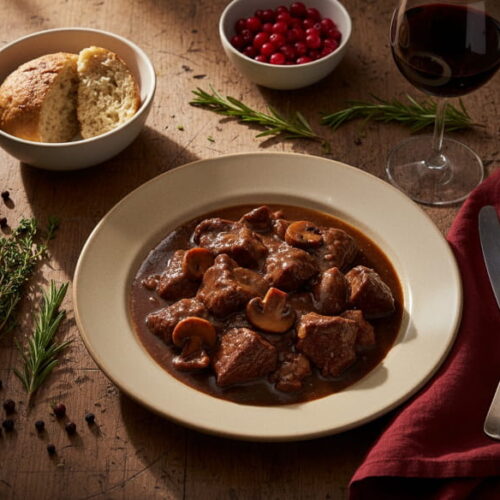
Wild boar goulash from the Eifel with mushrooms
Cooking utensils
- 1 Large casserole or roasting pan with lid
- 1 Large pan for the mushrooms
- 1 Kitchen knife and chopping board
- 1 Ladle
- 1 Strainer for straining
Ingredients
- 600 g Wild boar shoulder or leg cut into 3-4 cm cubes
- 2 Tbsp clarified butter
- 1 tablespoon tomato paste
- Salt black pepper
- 2 Tbsp flour for dusting
FOR THE BRAISING BROTH:
- 1 Onion Roughly diced
- 2 Carrots Roughly diced
- 1 Celery stalk Roughly diced
- 3 Garlic cloves pressed on
- 300 ml Mosel Pinot Noir dry or other dry red wine
- 200 ml Game stock or beef stock
- 3 Juniper berries crushed
- 2 Bay leaves
- 3 Sprigs of fresh thyme
- 1 sprig of fresh rosemary
FOR THE MUSHROOMS:
- 200 g Porcini mushrooms fresh or rehydrated
- 150 g Forest mushrooms
- 1 Tbsp butter
- 1 Garlic clove finely chopped
- Salt Pepper
Preparation
PREPARATION:
- Pat the wild boar meat dry, season with salt and pepper and dredge lightly in flour.
- Roughly dice the onions, carrots and celery.
- Clean and quarter the mushrooms; if dried, soak the porcini mushrooms in warm water for 20 minutes.
- Wash the herbs.
COOKING STEPS:
- Heat the clarified butter in a casserole over a high heat.
- Fry the wild boar cubes in batches until browned all over – not too much at once so that the meat takes on color.
- Remove the meat and set aside.
- Sauté the onions, carrots, celery and garlic in the roast residue.
- Add the tomato purée and fry briefly.
- Deglaze with the red wine and bring to the boil.
- Add the stock, juniper berries, bay leaf, thyme and rosemary.
- Return the meat to the pot.
- Cover and braise in the oven at 160 °C for 2 to 2.5 hours until the meat is tender.
- Remove the meat, strain the sauce through a sieve and reduce as required.
- Heat the butter in a pan and fry the mushrooms and garlic until golden brown.
- Season with salt and pepper.
- Return the mushrooms and meat to the sauce and heat briefly.
DIRECTIONS:
- Serve the goulash in deep plates.
- Pour in the sauce generously.
- Garnish with a sprig of thyme.
SUPPLEMENTS:
- Potato dumplings or bread dumplings
- Red cabbage with cranberries
- Preserved cranberries

