

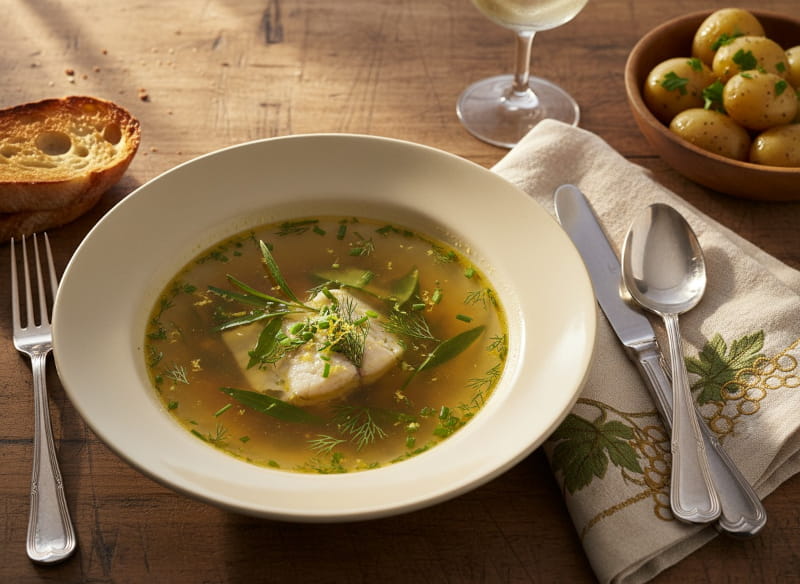
The king of Moselle waters – poached in its own wine
Combining wine and food is rarely as successful as with pike in herb and Riesling broth. The pike – Esox lucius, predator and patriarch of the Moselle waters – is the second largest fish in this region after the trout. Its meat is firmer, its aromas stronger and its texture denser than that of trout. It doesn’t need a thick sauce or a heavy side dish: it needs herbs, broth and a wine that brings out its natural flavor without overpowering it.
The herb and Riesling broth is more than just a cooking technique – it is a distillation of the flavors of the Moselle. Tarragon, parsley, dill and a dash of Riesling: these ingredients transform the pike into a dish that smells of the river, the herb garden and the autumn sun. Poached in an aromatic, wine-reduced broth, the pike infuses the Riesling flavor into the meat, releasing its own nutty umami into the broth. The result is a clear, golden liquid that you want to drink – and a fish that melts in your mouth like no other.
Ideal wine accompaniment: Mosel Riesling Spätlese dry QmP (Middle Mosel, Germany)
Ripe peach fruit, a hint of apricot, a taut, clear acidity and the unmistakable slate mineral tone of the Middle Moselle underneath – the Spätlese trocken is not a light wine, and that is exactly right. Because pike is not a light fish. Its flesh has more intrinsic weight than that of trout, its aromas are nuttier and deeper. The Spätlese trocken has enough body to stand up to this fish without overwhelming it.
What makes the Spätlese trocken with pike in herb-Riesling broth particularly harmonious is the mirroring principle: the wine in the glass carries the same Riesling aromas as the broth on the plate – peach, citrus, herbs, slate. If you drink the broth and take a sip of Spätlese trocken, you will experience a circular taste sensation: the wine prolongs the broth on the palate, the broth prepares the palate for the next sip of wine. From vineyards such as Ürziger Würzgarten or Graacher Himmelreich come dry Spätlese wines that complete this circular movement.
Further wine recommendations for this dish
Mosel Riesling Kabinett QmP (Middle Mosel, Germany)
The more delicate, light-footed alternative for those who find the dry Spätlese too rich in substance – the Mosel Riesling Kabinett is the most elegant wine produced by the Middle Mosel, and it works with the Hecht in a different but equally convincing way. Its residual sweetness – barely measurable, but clearly noticeable – cushions the natural spiciness of the Hecht and creates a harmony that the dry Spätlese creates through acidity. The Kabinett is lighter, fresher, more spring-like than autumnal – and it is precisely this freshness that goes particularly well when the pike has been seasoned with plenty of dill and lemon zest. A first choice for anyone serving pike with an elegant, light dinner.
Chablis AOC (Burgundy, France)
Chalk stone, iodine and a dry, unwooded style that leaves any thoughts of buttery Chardonnay far behind – Chablis is the most international and mineral alternative for pike in Riesling broth. Its Kimmeridgian chalk soils produce a freshness and precision that creates an exciting resonance with the herbal Riesling broth: Chablis has no Riesling aromas, but a similar mineral coolness that enters into a silent dialog with the broth. The difference to Riesling lies in the body – Chablis is creamier, rounder – and in the fruit, which is more citrus and less peachy. As a Premier Cru from Chablis, this alternative is even the right choice for a festive pike evening with guests.
Saar Riesling Spätlese dry QmP (Saar, Germany)
The cool, elegant sister of the Mittelmosel Riesling – on the Saar, where the climate is cooler and the slate soils are even stonier, a Riesling is produced with an acidic energy that really makes the palate vibrate. Compared to the Mittelmosel-Spätlese trocken, the Saar Riesling is leaner, more precise, with fruit that is more reminiscent of green apple and citrus peel than ripe peach. This coolness makes it the ideal accompaniment for a pike poached in a particularly herbal broth with lots of tarragon and little sweetness. From vineyards such as Ockfener Bockstein or Scharzhofberger come dry Saar Spätlese wines, which show why the Saar forms its own, unmistakable Riesling universe alongside the Middle Moselle.
Grüner Veltliner Wachau DAC Smaragd (Wachau, Austria)
White pepper, citrus peel, herbs and a minerality from the primary rock terraces of the Danube – Grüner Veltliner Smaragd is the Austrian answer to Mosel Riesling and a surprisingly harmonious accompaniment to pike. Its peppery spiciness provides a clear, spicy counterpoint to the herbal Riesling broth and creates a tension on the palate that makes the fish interesting: every bite of pike – steamed, soft, nutty – meets a sip of Veltliner, which responds with spice and minerality. The Smaragd, the highest quality level of the Wachau, has enough body to really stand up to the pike. An alternative for all those who like to combine Austrian wine with German fish.
Muscadet Sèvre et Maine AOC (Loire, France)
Matured sur lie, with a hint of yeast bread and a salty, almost iodine-like freshness – Muscadet is actually the companion to Atlantic oysters, but proves amazingly adaptable with pike in Riesling broth. Its bone-dry, sober nature forms an exciting contrast to the aromatic herbal broth: where the broth is rich and aromatic, the Muscadet is cool and ascetic. This contrast enlivens the pairing in an unexpected way – the fish emerges from the broth and reveals its own nutty texture. If you prepare the pike Müllerin-style – with butter and lemon – and serve the Riesling broth as a separate starter, Muscadet Sèvre et Maine is perhaps the most suitable non-Riesling companion.
All other recipes and wine recommendations from the Moselle region can be found in the Moselle wine region category.
The recipe:
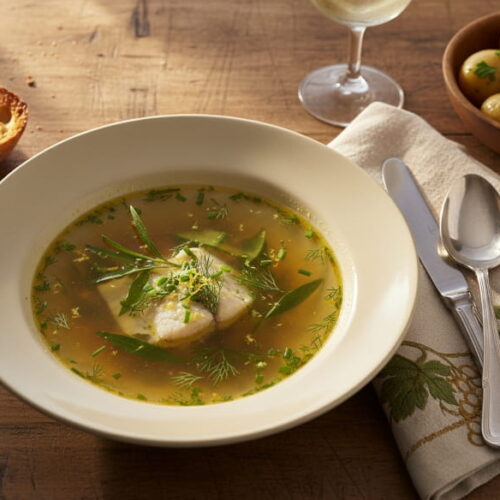
Pike in herb Riesling broth
Cooking utensils
- 1 Large wide pot or roasting pan
- 1 Ladle
- 1 Strainer for straining
- 1 Kitchen thermometer (optional)
- 1 Kitchen knife and chopping board
Ingredients
- 2 Pike fillets approx. 200 g each, boneless
- Salt white pepper
- 1 squeeze of lemon juice
FOR THE RIESLING BROTH:
- 300 ml Mosel Riesling dry
- 400 ml Fish stock
- 2 Shallots finely diced
- 1 Bay leaf
- 5 Peppercorns
- 1 teaspoon butter
FOR THE HERBS:
- 3 Sprigs of fresh tarragon
- 3 tablespoon fresh parsley finely chopped
- 2 Tbsp fresh dill finely chopped
- 1 Tbsp chives in rolls
TO DIRECT:
- 1 Tbsp butter
- Lemon zest
- Fresh dill
Preparation
PREPARATION:
- Rinse the pike fillets in cold water, pat dry and check for bones.
- Season the fillets with salt, white pepper and a squeeze of lemon juice.
- Peel and finely dice the shallots.
- Wash the herbs, shake dry and chop finely.
- Grate the lemon zest.
COOKING STEPS:
- Melt the butter in a saucepan over a medium heat.
- Sweat the shallots until translucent – do not brown.
- Deglaze with the Riesling and reduce by half.
- Add the fish stock, bay leaf and peppercorns.
- Allow the stock to simmer for 10 minutes over a low heat.
- Reduce the heat considerably – the brew should remain below boiling point, approx. 80-85 °C.
- Carefully place the pike fillets in the stock.
- Poach for 8-10 minutes until the meat is white and firm.
- Carefully lift out the fillets and keep warm.
- Pass the stock through a fine sieve.
- Stir in the remaining butter and add the herbs (except the chives) to the hot stock.
DIRECTIONS:
- Arrange the pike fillets in deep soup bowls.
- Generously pour in the Riesling-herb stock.
- Sprinkle with chives and lemon zest.
- Serve immediately.
SUPPLEMENTS:
- New potatoes tossed in butter
- Crispy sourdough bread for dipping
- Green salad with lemon vinaigrette

