
Floor under glass – when the Eifel and Moselle meet
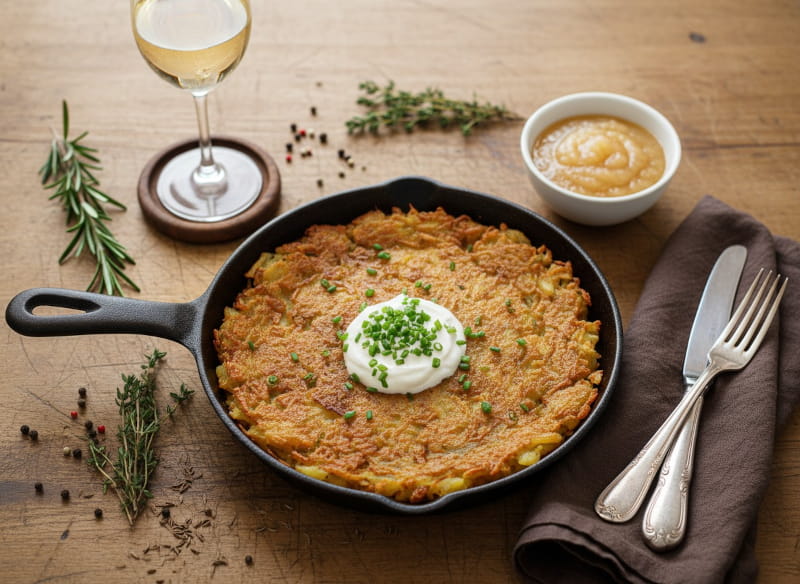
Finding the right wine to accompany a dish that sounds like home from the name alone is particularly enjoyable. Dibbelabbes – the term comes from Moselle-Franconian and means something like “lump from the cast iron pot” – is the most down-to-earth specialty that the Eifel-Moselle region has to offer. Grated potatoes, smoked bacon, onions, caraway seeds and a hint of marjoram: they slowly fry together in the cast-iron pan until a golden brown crust forms on the outside and a steaming, spicy interior awaits.
This dish is warmth, tradition and memory on a plate. It comes from the kitchen of the common people, from farmhouses along the Eifelmosel, where every bit of warmth counted in winter and every ingredient had to have a reason. Today, it lives on as a cherished classic – and deserves a wine that respects its down-to-earth honesty without overpowering it: the semi-dry Mosel Riesling QbA. Accessible, regional, fresh – a wine that makes as little fuss about itself as the dish itself, and yet makes for an unforgettable evening together with it.
Ideal wine accompaniment: Mosel Riesling QbA semi-dry (Mosel, Germany)
A hint of residual sweetness – barely 8 to 12 grams per liter – and the typical Mosel freshness underneath: this combination makes it the ideal sparring partner for the spicy dibbelabbes. The sweetness cushions the spiciness of the caraway, the Moselle acidity cuts through the fat of the smoked bacon and makes every bite of the potato dish fresh. The fruit – green apple, peach, a hint of lemon zest – contrasts brightly with the fried earthiness of the dish.
What distinguishes a semi-dry Mosel Riesling QbA from a dry one is precisely this balance: it is neither sweet enough to be a dessert wine, nor so dry that the spice of the dish hits the palate unchecked. It is center, balance, harmony – and that is exactly what a rustic dish like dibbelabbes needs to convince even wine-savvy palates. As a simple QbA from the region, accessible and inexpensive, it has everything this evening requires.
Further wine recommendations for this dish
Mosel Riesling Kabinett QmP feinherb (Middle Mosel, Germany)
A small step up the quality pyramid – and a big step in the nuance of the pairing. The Kabinett feinherb lies between dry and semi-dry and brings a finesse that the simple QbA lacks: more minerality from the slate soil, more depth in the fruit, a more precise acid structure. As an accompaniment to dibbelabbes, it unfolds its potential particularly when the dish is served with fresh quark or sour cream – the residual sweetness of the Kabinett combines with the lactic acidity of the quark to create a harmony that goes far beyond what you would expect from an everyday dish. A Kabinett feinherb from a winery such as Loosen or Selbach-Oster shows what the Moselle is really capable of in this style.
Palatinate Pinot Gris QbA dry (Palatinate, Germany)
Full-bodied, mild and with a slight nuttiness reminiscent of almonds and white pears – Pinot Gris from the Palatinate is the most flattering alternative for anyone who doesn’t want Riesling with their dibbelabbes. Its moderate acidity does not overwhelm the dish, its body keeps pace with the fat of the bacon and the satiety of the potato. The combination is particularly successful when the dibbelabbes is served with fried onions and a dollop of apple sauce – then the light pear-nuttiness of the Pinot Gris combines with the apple to create a flavorful unity that one would not have expected. Pinot Gris Palatinate is the wine for anyone who still wants a little flattery on the palate with a rustic dish.
Franconia Silvaner QbA dry (Franconia, Germany)
Mineral, dry and with an earthiness that comes from the shell limestone soils of Franconia and that you can feel immediately at the first sip – the Silvaner is the most surprising but most harmonious guest on this list. It shares a down-to-earth attitude with the Dibbelabbes: both come from a cuisine that does not compromise on elegance, but instead focuses on authenticity. The herbaceous spiciness of the Silvaner, its mineral finish and its dry structure form a clear, sober contrast to the spiciness of the dish – and it is precisely this sobriety that does the Dibbelabbes good. Serving Silvaner in a Bocksbeutel sends out a signal: this is where one of the most traditional German grape varieties meets one of the most traditional Eifel dishes.
Mosel Auxerrois QbA dry (Obermosel, Germany)
The regional secret recommendation for dibbelabbes – the Auxerrois from the Upper Moselle is deeply rooted in the Saar and Upper Moselle and has a creamy, full-bodied flavor that goes wonderfully with the fatty bacon and potato dish. Its white-floral aromas, a hint of chamomile and ripe pear, act as a counterpoint to the spiciness of the caraway – fresh, but never overpowering. The moderate acidity of the Auxerrois does not overwhelm the dish, its body is enough to keep pace with the bacon. If you are serving dibbelabbes as a regional dinner on the Moselle and would like to drink a wine from the region with it, but shy away from the acidity of Riesling, Auxerrois is the perfect, down-to-earth, regional answer.
Rheinhessen Riesling QbA dry (Rheinhessen, Germany)
Milder than the Mosel Riesling, softer in acidity and with a fruit more in the direction of ripe peach and melon – the Rheinhessen Riesling is the most accessible Riesling alternative for all those who appreciate the typical Mosel acidity less. The softer style of Rheinhessen Riesling works well with a dish like dibbelabbes, which already has enough spice thanks to the caraway, bacon and roasted potatoes: it flatters without dominating, it refreshes without being sharp. For a relaxed Eifelmosel evening with dibbelabbes as the main course, it is the most uncomplicated and inexpensive choice – an everyday wine for an everyday dish that is nevertheless special.
All other recipes and wine recommendations from the Moselle region can be found in the Moselle wine region category.
The recipe:
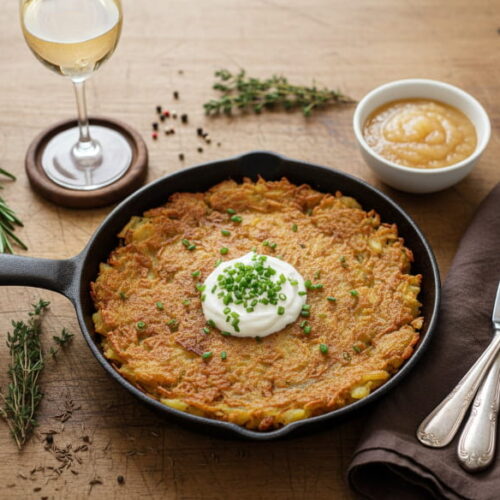
Dibbelabbes (potato and bacon pan from the Eifel region)
Cooking utensils
- 1 Cast iron pan or wrought iron pan (26-28 cm)
- 1 Grater or kitchen grater
- 1 Clean kitchen towel to wring out
- 1 Bowl for mixing
- 1 Kitchen knife and chopping board
Ingredients
- 600 g Potatoes raw, peeled
- 150 g Smoked bacon diced
- 1 Onion finely diced
- 2 Eggs
- 1 teaspoon caraway seeds
- 1 tsp marjoram Dried
- Salt black pepper
- 2 Tbsp clarified butter or lard
TO DIRECT:
- 4 Tbsp sour cream or quark
- 1 Tbsp chives cut into fine rolls
Preparation
PREPARATION:
- Peel the potatoes and grate with a coarse grater.
- Place the grated potatoes in a clean kitchen towel and squeeze them out thoroughly – as dry as possible.
- Dice the bacon.
- Peel and finely dice the onion.
- Wash the chives and cut into fine rolls.
COOKING STEPS:
- Fry the bacon in a pan over a medium heat without fat until crispy.
- Add the onions and sauté until translucent.
- Remove the bacon and onion mixture from the pan and set aside briefly.
- Place the mashed potatoes in a large bowl.
- Add the eggs, caraway seeds, marjoram, salt and pepper.
- Fold in the bacon and onion mixture and mix well.
- Heat the clarified butter in a frying pan over a medium heat.
- Pour the potato mixture into the pan and press flat.
- Fry over a medium heat for 15-18 minutes until the underside is golden brown and crispy.
- Place a large plate on the pan, turn the pan over and slide the dibbelabbes back into the pan.
- Fry for a further 12-15 minutes until the second side is also golden brown.
DIRECTIONS:
- Serve the dibbelabbes on a warmed plate.
- Garnish with a generous dollop of sour cream.
- Sprinkle with fresh chives.
SUPPLEMENTS:
- Sour cream or quark with chives
- Homemade apple sauce
- Green leaf salad with wine vinegar vinaigrette

