

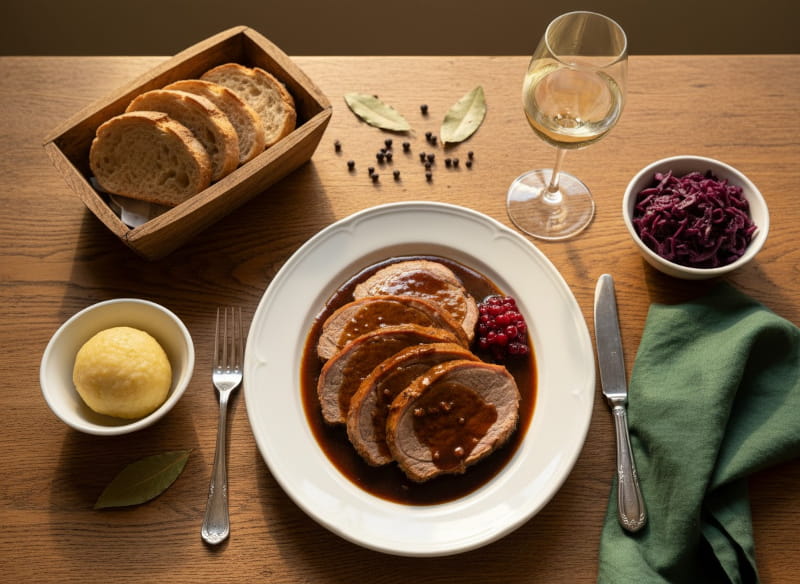
Sweet, sour, spicy – a new interpretation of the Moselle sauerbraten
Combining wine and food – with this dish, that means more than just choosing the right accompaniment. Riesling is part of the recipe for Mosel sauerbraten: it forms the basis of the marinade in which the beef is allowed to mature for two to three days before it goes into the oven. The result differs fundamentally from Rhenish sauerbraten, which is dominated by red wine vinegar and dark sauce: Mosel sauerbraten is lighter, finer, with a subtle wine fruit in the meat and a sauce built on Riesling reduction, raisins and gingerbread.
This dish is patience in its purest form. The pickling time of at least 48 hours cannot be shortened – nor should it. Those who wait will be rewarded: with meat that smells like an open Riesling glass when sliced and a sauce that you would love to spoon up. We recommend pairing it with a fine, tart Spätlese, which picks up on the sweet and sour play of the sauce and continues it masterfully on the palate.
Ideal wine accompaniment: Mosel Riesling Spätlese QmP feinherb (Mittelmosel, Germany)
Ripe peach fruit, a hint of honey and the taut Mosel acidity underneath that holds everything together – this Spätlese feinherb moves in the golden mean between dry and sweet and thus hits exactly the aromatic space that the dish needs. The residual sweetness – between 15 and 25 grams per liter – reflects the sweetness of the raisins and gingerbread in the sauce without being sweet itself. This is the work of art of the feinherb Spätleses: It balances where other wines seem either too harsh or too flattering.
The acidity is the decisive element: it cuts through the richness of the braising sauce, bringing freshness to a dish that tends to be somewhat heavy after a long braising time and intense sauce. The slate mineral on the finish extends the acidic freshness well into the aftertaste and makes every sip a new reason to take another forkful of meat. Finely tart Spätlese wines are available from the Graacher Himmelreich or Piesporter Goldtröpfchen vineyards, which elevate this pairing to a festive level.
Further wine recommendations for this dish
Mosel Riesling Auslese QmP (Middle Mosel, Germany)
Even a step sweeter than the Spätlese – and yet harmonious with sauerbraten, because the sauce itself has a complex sweet and sour profile due to the raisins, gingerbread and vinegar, which does not overwhelm a noble sweet wine, but invites it. The Auslese brings golden honey aromas, apricot jam and a depth that elevates the dish towards a festive meal. The taut Riesling acidity of the Auslese – a distinctive feature of the Moselle despite its sweetness – prevents the pairing from drifting into oversweetness. As a festive dinner, when the sauerbraten takes the lead role in a multi-course Mosel menu, the Auslese is the boldest and most rewarding choice on this list – a wine that will keep guests silent before they start talking.
Rheingau Riesling Spätlese QmP feinherb (Rheingau, Germany)
Slightly fuller-bodied than its Mosel counterpart, with fruit that leans more towards ripe pears and apricots and a body that has a little more substance thanks to the warmer Rheingau climate – this Spätlese feinherb is the Rheingau answer to the Mosel pairing. It works in the same way when paired with Mosel sauerbraten: It mirrors the sweetness of the sauce, the acidity cuts through the meat, the mineral tone extends the finish. The difference is subtle but noticeable: more weight, more maturity, slightly less slate minerality. For wine connoisseurs who like to compare, a glass of Rheingau alongside the Mosel at a sauerbraten dinner is a highly interesting parallel tasting.
Pfalz Riesling Spätlese dry QmP (Pfalz, Germany)
Dry, i.e. without residual sweetness – and therefore the most structurally sophisticated wine on this list. The Pfalz Riesling Spätlese trocken offers maximum depth of ripeness without the sweet flattery of a finely tart wine. This makes it the ideal companion for anyone who prefers their sauerbraten with a less sweet sauce – if raisins and gingerbread have been used a little more sparingly and the braised jus is dry and spicy rather than sweet and sour. The Pfalz-Spätlese trocken then brings the ripeness of the warm year, the depth of the terroir and a mineral spiciness that interprets the dish in a Mediterranean-German way that is only possible in the Palatinate.
Mosel Riesling Kabinett QmP feinherb (Middle Mosel, Germany)
The lighter, more accessible version for those who find the Spätlese too complex or too expensive – the Kabinett feinherb is the everyday companion for a weekday sauerbraten, when the dish is simpler and the wine should not overpower the dish. With less residual sweetness than the Spätlese and a somewhat leaner body, it is particularly suitable when the sauce is rather light and aromatic – i.e. when Riesling pickle, bay leaf and juniper berries dominate and raisins are only present as an accent. The Mosel minerality of the Kabinett is retained even when it is off-dry, creating a clean, fresh finish that is soothing after the rich stew.
Grüner Veltliner Wachau DAC (Wachau, Austria)
White pepper, citrus zest, a hint of herbs and a minerality from the primary rock terraces of the Danube – the Grüner Veltliner Wachau is the Austrian alternative that works surprisingly well with Mosel sauerbraten. Its dry spiciness and striking acidity make it the structural counterpart to the finely tart Riesling: while the Mosel Spätlese mirrors the sweet and sour profile of the sauce, the Grüner Veltliner cuts right through it and creates clear, spicy contrasts. As a Smaragd from the Wachau – the highest quality level – it has a long, mineral finish that lingers on the palate long after the last bite of sauerbraten. A wine for anyone who wants to discover Austrian alternatives to Riesling.
All other recipes and wine recommendations from the Moselle region can be found in the Moselle wine region category.
The recipe:
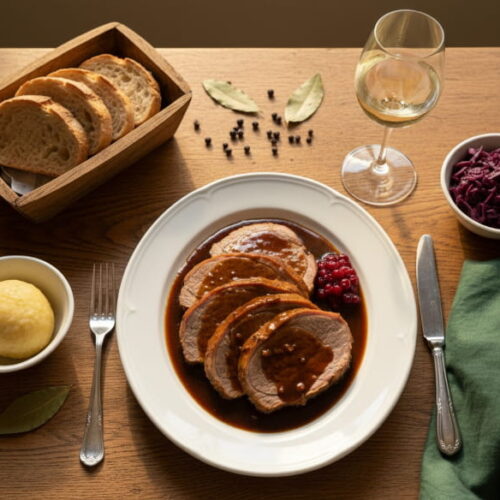
Mosel sauerbraten with Riesling pickle
Cooking utensils
- 1 Large roasting pan with lid
- 1 Sieve for straining the stain
- 1 Meat thermometer
- 1 Whisk
- 1 Kitchen knife and chopping board
Ingredients
- 800 g Roast beef Shoulder or bow, in one piece
- 2 Tbsp clarified butter
- 1 tablespoon tomato paste
- Salt black pepper
FOR THE RIESLING PICKLE:
- 400 ml Mosel Riesling dry
- 200 ml White wine vinegar
- 200 ml Water
- 1 Onion Roughly diced
- 1 Carrot Roughly diced
- 2 Bay leaves
- 5 Juniper berries slightly crushed
- 8 Peppercorns
- 2 Carnations
- 1 tsp sugar
- 1 teaspoon salt
FOR THE SAUCE:
- 200 ml Vegetable or beef stock
- 50 g Raisins
- 2 Slices of gingerbread
- 1 Tbsp beet syrup or brown sugar
- Salt Pepper to taste
Preparation
PREPARATION:
- Bring all the ingredients for the marinade to the boil in a pan and simmer for 10 minutes.
- Allow the pickle to cool completely.
- Place the roast beef in the cooled marinade – the meat must be completely covered.
- Cover and leave to infuse in the fridge for 48 to 72 hours.
- Turn the meat daily.
COOKING STEPS:
- Remove the meat from the marinade and pat dry.
- Strain the pickle through a sieve and keep the liquid.
- Heat the clarified butter in a roasting tin over a high heat.
- Sear the meat well on all sides until it is colored on all sides.
- Season with salt and pepper.
- Add the tomato purée and fry briefly.
- Deglaze with 300 ml of the strained pickling liquid.
- Add the stock, raisins and gingerbread.
- Cover and braise in the oven at 160 °C for 2.5 to 3 hours.
- Remove the meat, cover and leave to rest.
- Pass the sauce through a fine sieve.
- Season to taste with beet syrup, salt and pepper and reduce to the desired consistency.
DIRECTIONS:
- Cut the sauerbraten into slices and arrange on warmed plates.
- Pour the sauce generously over the meat.
- Garnish with cranberries or a few raisins.
SUPPLEMENTS:
- Potato dumplings (Thuringian or Franconian style)
- Red cabbage with apple and cloves
- Gherkins as a garnish

