


The cake that makes you silent – Naples’ greatest dessert and its rarest wine
Wine and food combine in the Pastiera Napoletana to create a moment that transcends the palate. There is a Neapolitan legend that says that Maria Teresa of Austria – known as the woman without a smile – began to smile when she took her first bite of pastiera. Her husband King Ferdinand II is said to have responded: “Per far ridere mia moglie ci voleva la pastiera” – “To make my wife laugh, it took the pastiera.” Whether the story is true or not, everyone who eats pastiera Napoletana for the first time understands it immediately.
Pastiera is not an easy cake. It is a ritual, an Easter promise, two days’ work – the dough, the ricotta filling with orange blossom water, the wheat grain cream (grano cotto), the cedro fruit and candita fruit, all baked in a shortcrust pastry until the cake is golden brown and the whole stairwell smells of orange blossom. It’s better the next day. Even better the day after tomorrow. It is one of the few dishes in the world where waiting is not a compromise, but part of the recipe. The accompanying wine – a Fiano di Avellino Passito DOCG – is just as rare and extraordinary as the cake itself.
Ideal wine accompaniment: Fiano di Avellino Passito DOCG (Campania, Italy)
Preserved apricot, orange zest, candied citrus peel, a hint of honey and the typical Fiano minerality from the limestone soils of Irpinia, which is still recognizable even in the Passito expression and never makes the wine heavy despite its sweetness – the Fiano di Avellino Passito is the Campanian answer to a dessert wine that does not flatter the dish, but speaks to it at eye level.
With the Pastiera Napoletana, it unfolds through a threefold aromatic combination. The orange zest in the wine picks up on the orange blossom water in the filling and doubles it on the palate. The candied citrus note of the Fiano Passito mirrors the cedro and candita fruits in the cake. And the apricot depth of the wine combines with the creamy ricotta filling to create a melt-in-the-mouth texture that lingers on the tongue and needs no further comment. The Fiano minerality in the finish – cool, chalky, precise – prevents the pairing from collapsing into pure sweetness: it straightens the palate after every sip and makes the next bite of pastiera possible, even though you’ve already had enough. Fiano Passito from wineries such as Pietracupa, Ciro Picariello and Di Meo bring this Easter Sunday moment to its most complete form.
Further wine recommendations for this dish
Greco di Tufo Vendemmia Tardiva DOCG (Campania, Italy)
The Campanian counterpart to the late harvest – Greco di Tufo, harvested late, with more concentrated fruit and more residual sweetness than the dry version, but without the Passito intensity. Its tangerine and grapefruit flavors provide a fresher, livelier contrast to the Pastiera than the richer Fiano Passito – less melting, more tension. For all those who want to accompany their pastiera with a wine that does not double the sweetness of the cake, but counteracts it with freshness and slight bitterness, the Greco Vendemmia Tardiva is the more harmonious, exciting alternative. Especially if the pastiera is very sweet, this wine with its characteristic bitterness on the finish is the ideal companion.
Moscato d’Asti DOCG (Piedmont, Italy)
Light, sparkling, with a nutmeg note and a floral freshness unlike any other dessert wine in the world – Moscato d’Asti is Italy’s most accessible and popular dessert wine and pairs with pastiera in an immediate, flattering way. Its peach and apricot aromas pick up on the fruity notes of the candita fruit, its light sweetness harmonizes with the ricotta, and its effervescence prevents the pairing from feeling heavy after the slice of cake. Moscato d’Asti is the perfect choice for Easter Sunday afternoons when the pastiera is on the table and everyone should relax and drink it by the glass.
Vin Santo del Chianti DOC (Tuscany, Italy)
Amber, almonds, dried fruit, a hint of vanilla and the oxidative depth that only comes from long ageing in caratello – the small Tuscan wooden barrel: Vin Santo del Chianti is Italy’s most traditional dessert wine and an accompaniment for pastiera that brings a different dimension to pairing. Its nutty oxidation provides a warm, amber-colored contrast to the pastiera’s floral orange notes, and its almond and dried fruit notes combine with the ricotta cream in a rich, melting way. For those looking to serve pastiera at the end of a long feast and pair it with a wine with history and depth, Vin Santo is the most worthy non-Campania choice on this list.
Banyuls AOC (Roussillon, France)
A Vin Doux Naturel made from Grenache Noir – dark, with cherry, dark chocolate and a hint of coffee, and at first glance the boldest choice for the Pastiera. And yet it works: the orange blossom note of the Pastiera and the dark chocolate-cherry of the Banyuls create a tension that is surprisingly harmonious – a contrast that makes both sides more interesting. The Banyuls is for those who don’t accompany the Pastiera with a flattering, sweet wine, but one that keeps the conversation alive after the last bite. Bold, but rewarding.
Sauternes AOC (Bordeaux, France)
Honey, saffron, candied citrus peel, apricot jam and the oily texture that only botrytized Sémillon from the Bordelais has – Sauternes is the most famous dessert wine internationally, and with Pastiera Napoletana it shows why. Its citrus and orange notes mirror the orange blossom water in the cake in a broad, flattering way, and its honeyed depth combines with the ricotta to create a long, silky finish. It is more voluptuous than the Fiano Passito and has less Campania character, but for those who serve the Pastiera as a festive dessert of an international menu, it is the most elegant and prestigious alternative on this list.
All other recipes and wine recommendations from Campania can be found in the Campania wine region category.
The recipe:
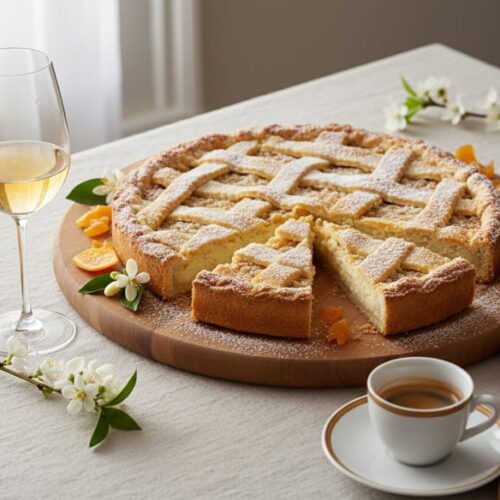
Pastiera Napoletana
Cooking utensils
- 1 Pastiera dish or 26 cm springform pan (preferably with grooves)
- 1 Food processor or hand mixer
- 1 Small bowl for the grano cotto
- 1 Kitchen knife and chopping board
- Cling film
- 1 Rolling Pin
Ingredients
FOR THE SHORTCRUST PASTRY (PASTA FROLLA):
- 300 g Flour type 00
- 150 g Cold butter diced
- 120 g Sugar
- 2 Egg yolk
- 1 Egg
- 1 Pinch of salt
- Zest of 1 untreated lemon
FOR THE FILLING:
- 300 g Grano cotto Cooked durum wheat from the tin, available in Italy
- 150 ml Whole milk
- 1 Tbsp butter
- Zest of 1 untreated orange
- 500 g Ricotta Sheep or cow ricotta, well drained
- 250 g Sugar
- 4 Eggs separate
- 3 Tbsp orange blossom water
- 100 g candied orange peel Cedro or Arancia candita, finely diced
- 1 teaspoon cinnamon
- 1 Pinch of salt
TO FINISH:
- Powdered sugar for dusting
Preparation
PREPARATION:
- For the shortcrust pastry: work the flour, sugar, salt and butter into a crumbly dough.
- Add the egg yolks, egg and lemon zest and knead quickly to form a smooth dough – do not overwork.
- Wrap the dough in cling film and chill for at least 1 hour, preferably overnight.
- For the grano cotto: Heat the grano cotto with the milk, butter and orange zest in a small saucepan over a low heat for 10 minutes and stir until creamy. Leave to cool.
COOKING STEPS:
- Preheat the oven to 170 °C top/bottom heat.
- Pass the ricotta through a fine sieve for a particularly smooth filling.
- Mix the ricotta with the sugar, egg yolks, orange blossom water, cinnamon and candied fruit.
- Stir in the grano cotto.
- Beat the egg whites with a pinch of salt until firm.
- Carefully fold the beaten egg whites into the ricotta mixture.
- Roll out the shortcrust pastry on a floured surface, line the tin with it, raise the edges.
- Fill the ricotta filling evenly.
- Cut the remaining dough into strips and arrange as a lattice on the filling – the characteristic pattern of the pastiera.
- Bake in the oven for 55-60 minutes until the filling has set and the lattice is golden brown.
- Leave to cool completely – at least 4 hours, preferably overnight.
DIRECTIONS:
- Dust the pastiera with powdered sugar.
- Cut into pieces and arrange on plates.
- Serve at room temperature – never straight from the fridge.
SUPPLEMENTS:
- Fiano di Avellino Passito DOCG, slightly chilled (10-12 °C)
- A cup of espresso to accompany dessert
- No side dishes on the second day – she won’t need any more

