

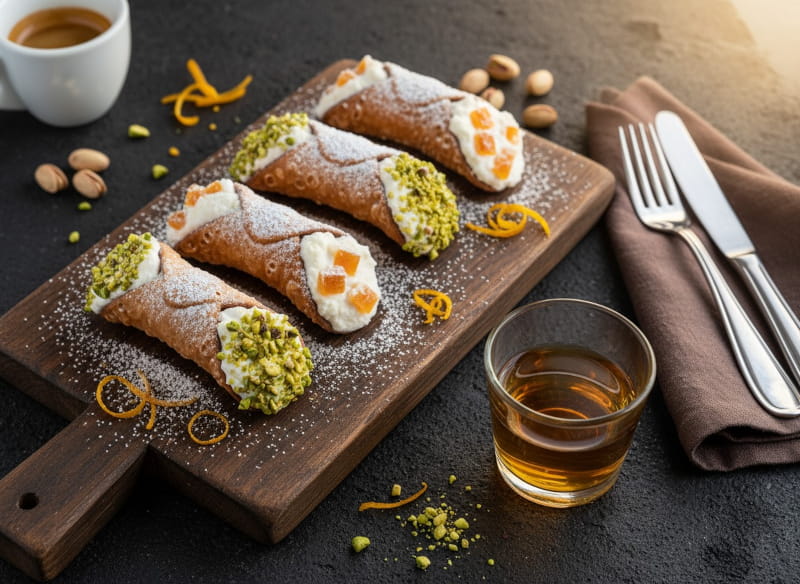
The most famous pastry in the world – and the wine that is just as old as its fame
Combining wine and food rarely has such a cinematographic dimension as at Cannolo. “Leave the gun, take the cannoli” – the most famous line from The Godfather, spoken by Peter Clemenza, who has promised his wife to bring cannoli while he is assisting in a contract killing. Francis Ford Coppola never explained this phrase because he didn’t have to: anyone who has eaten a cannoli understands why you take it with you even under the most adverse circumstances.
Cannolo is not a Sicilian specialty – it is the Sicilian specialty. A crispy, deep-fried pastry tube (scorza) filled with sweetened sheep’s ricotta, candied fruit, pistachio pieces or chocolate chips – depending on origin and family preference. In the province of Palermo, it is the purest form: Ricotta, candied orange peel, pistachios at the ends. In Catania, bitter chocolate is added. In Agrigento, vanilla is added. The only thing everyone agrees on is that the cannolo should only be filled just before it is eaten, otherwise the scorza will soften and the miracle will be over. The Marsala Superiore DOC in the glass is the most historically coherent companion – old, complex, Sicilian down to the last drop.
Ideal wine accompaniment: Marsala Superiore DOC (Sicily, Italy)
Nutty, dried fruit, caramel, a hint of candied orange zest and an underlying oxidative depth that comes from long ageing in wooden barrels and the centuries-old Marsala tradition – Marsala Superiore DOC is not just a wine, it is a piece of Sicilian history. Since John Woodhouse discovered at the end of the 18th century that the Grillo wine from Trapani became more durable with a dash of ethyl alcohol, Marsala has sailed the seas of the world – as a wine for Admiral Nelson’s fleet, as an ingredient of Scaloppine al Marsala in the kitchens of the world and today as the only fortified wine in Italy with DOC status.
With the Cannolo siciliano, the Marsala Superiore unfolds through a triple aromatic combination. Its nutty notes – walnut, almond, a hint of hazelnut – resonate with the ricotta and the pistachio pieces on the Cannolo in a warm, melting way. Its candied citrus note mirrors the candied orange peel in the filling – not as a doubling, but as an extension, as if the wine is continuing the work of candying that the pastry chef started. And its oxidative caramel depth combines with the crisp, deep-fried scorza to create a moment when pastry and wine cease to be two things and become one. As a semi-dry or sweet Superiore – always served in small glasses, always at room temperature – it is the most worthy conclusion to a Sicilian dinner. Marsala Superiore comes from producers such as Florio, Marco de Bartoli and Pellegrino, who bring the Cannolo to its most historically complete form.
Further wine recommendations for this dish
Passito di Pantelleria DOC (Sicily, Italy)
Honey, apricot, mandarin, fig and the volcanic depth of the Zibibbo grape from the island of Pantelleria – the Passito di Pantelleria is the Sicilian dessert wine par excellence and a companion for the Cannolo, which surpasses the Marsala in fruit intensity but is inferior in historical connection. Its apricot and honey depth combines with the ricotto in a direct, flattering way, and its Sicilian origins make the pairing a double island statement. For those who prefer a fruitier, less oxidative dessert wine with Cannolo, the Passito di Pantelleria is the first Sicilian alternative.
Moscato d’Asti DOCG (Piedmont, Italy)
Light, tangy, with peach, apricot and a nutmeg note that no other wine in the world produces so purely – Moscato d’Asti is Italy’s most accessible dessert wine and a surprising accompaniment to cannolo: its effervescence cuts through the sweetness of the ricotta filling and makes the pastry lighter than it is. Its muscat fruit provides a floral contrast to the heavy sheep’s ricotta, and its low alcohol – never over 5.5 percent – makes it inviting even for the third round. If you don’t want something heavy in your glass after a long dinner, choose Moscato d’Asti – light, honest, perfect.
Vin Santo del Chianti DOC (Tuscany, Italy)
Amber, almonds, dried fruit and the oxidative depth of long Caratello ageing – Vin Santo is Italy’s most traditional dessert wine and more structurally similar to Marsala than any other wine on this list. Its almond-dry fruit notes combine with the ricotto in a rich, nutty way, and its oxidative depth resonates with the crunchy scorza in a similarly harmonious way to Marsala. For those who like to stay Tuscan with the Cannolo and find the Marsala too Sicilian, the Vin Santo del Chianti is the most harmonious alternative – and a reason to think about the connection between Italy’s two oldest dessert wines.
Banyuls AOC (Roussillon, France)
A Vin Doux Naturel made from Grenache Noir – dark, with cherry, dark chocolate and a hint of coffee: the boldest companion on this list and, for cannoli with dark chocolate in the filling, the most precise. Its chocolate note doubles the bitterness of the chocolate chips in the cannolo and creates an intensity that brings both to their maximum. For those who prefer the Catanese version of Cannolo – with bitter chocolate and less pistachio – Banyuls is the only wine on this list that is fully up to the task.
Sauternes AOC (Bordeaux, France)
Honey, saffron, candied citrus peel, apricot jam – the Sauternes is the French equivalent of Marsala as a dessert wine reference and a companion for the Cannolo, taking the boundaries of Sicilian cuisine beyond the Mediterranean. Its candied citrus notes mirror the orange peel in the filling in a luscious, melting way, and its honeyed depth combines with the ricotto for a long, satisfying finish. It is more expensive than the Marsala, more opulent and less historically connected – but as a one-off evening moment, when the cannolo is the last dish on a big menu, it is unrivaled.
You can find all other recipes and wine recommendations from Sicily in the Sicily wine region category.
The recipe:
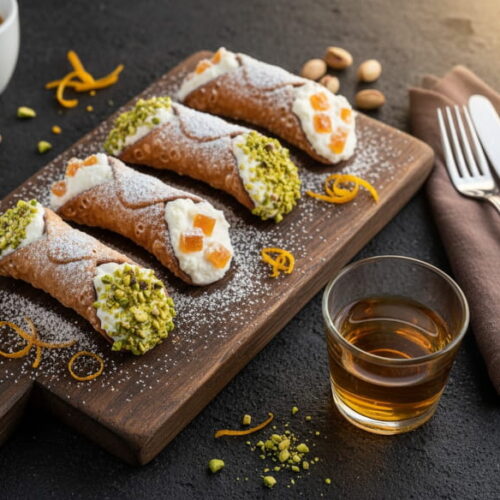
Cannoli siciliani
Cooking utensils
- 1 Cannoli molds (metal tubes, approx. 12 cm long, 2 cm diameter)
- 1 Deep frying pan or deep pan
- 1 Kitchen thermometer
- 1 Pasta rolling pin or pasta machine
- 1 Piping bag for the filling
- Kitchen paper
Ingredients
FOR THE SCORZA (DOUGH TUBES):
- 200 g Flour type 00
- 1 Tbsp sugar
- 1 Tbsp cocoa powder optional – for the darker version
- 1 Pinch of cinnamon
- 1 Pinch of salt
- 30 g Lard or butter soft
- 1 Egg
- 50 ml Marsala or white wine
- Oil for deep-frying
FOR THE RICOTTA FILLING:
- 500 g Sheep ricotta Drain well, at least 2 hours in a sieve
- 150 g Powdered sugar sieved
- 50 g candied orange peel very finely diced
- 1 teaspoon vanilla extract
- 50 g Dark chocolate 70 %, finely chopped (optional)
TO GARNISH:
- Chopped pistachios unsalted, natural green
- Candied cherries or orange peel
- Powdered sugar for dusting
Preparation
PREPARATION:
- Drain the ricotta in a fine sieve for at least 2 hours – the drier it is, the better the filling.
- For the dough: Mix the flour, sugar, cocoa, cinnamon and salt.
- Work in the lard until the mixture is crumbly.
- Add the egg and Marsala and knead into a smooth, non-sticky dough.
- Wrap in cling film and chill for 1 hour.
- For the filling: mix the ricotta with the powdered sugar and vanilla until smooth.
- Stir in the candied orange peel and chocolate.
- Pour into a piping bag and chill.
COOKING STEPS:
- Roll out the dough thinly (approx. 2 mm) and cut out circles 10-12 cm in diameter.
- Roll each circle loosely around an oiled cannoli mold and stick the ends together with a little egg.
- Heat the oil to 175 °C.
- Fry the cannoli with the mold for 2-3 minutes until golden brown.
- Remove, leave to cool briefly, then carefully pull out the mold.
- Drain on kitchen paper and leave to cool completely.
DIRECTIONS:
- Fill the scorze just before serving – never before.
- Using a piping bag, pipe the ricotta filling into the pastry tubes from both sides.
- Dip the ends in chopped pistachios or candied fruit.
- Dust with powdered sugar.
- Serve immediately.
SUPPLEMENTS:
- Marsala Superiore DOC, room temperature, in small glasses
- Espresso as an alternative
- Never serve pre-filled

