

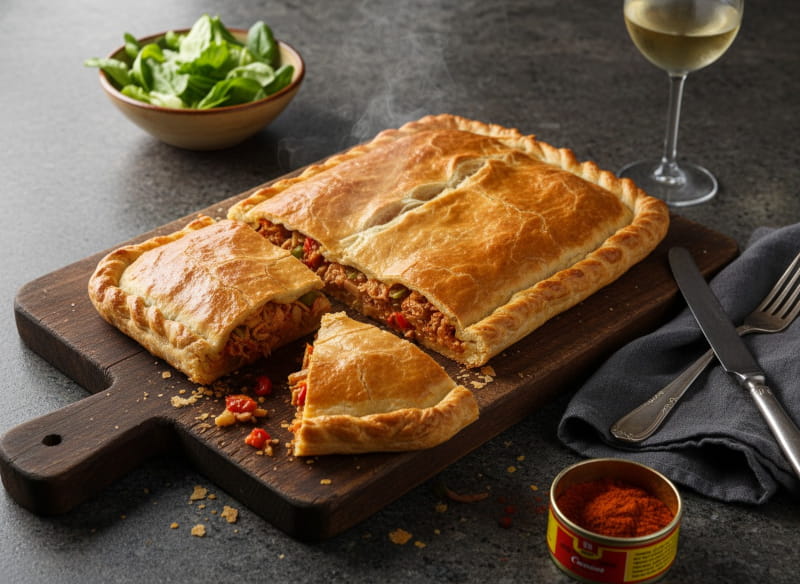
The Galician pastry coat – and the wine that hardly anyone knows, but everyone should know
Combining wine and food, the empanada gallega is the first thing you need to know: this is not a Spanish empanada. Anyone familiar with the crescent-shaped, deep-fried or baked individual pockets from Argentina or Chile is faced with a different dish. The Galician empanada is a pie – large, flat, baked in a pan, with two layers of dough and a spicy filling between them. The pastry is made with olive oil, golden brown and crispy on the edges, but softer and absorbent on the inside: it soaks up the liquid from the filling, transforming from a pastry into something that no other dish can match.
The filling of the empanada gallega de atún is the sofrito: onions and green peppers, sautéed in olive oil over a very low heat until they almost caramelize. Add tomatoes, pimentón and white wine. And then tuna – canned tuna in Galician cuisine, as Galicia’s canning and fish processing culture is one of the best in the world and Galician canned tuna is actually better than fresh tuna from a poor source. The result is a dish that tastes equally good hot, lukewarm and cold, that is better the next day than the day before and that requires no tools other than a knife to eat. Godello from the Valdeorras DO is the wine that has enough body and depth to carry this batter.
Ideal wine pairing: Godello Valdeorras DO (Galicia, Spain)
Pear, quince, white flowers, fresh herbs and a minerality that comes from the gray slate of the Valdeorras slopes on the Río Sil – Godello is Galicia’s second white wine answer to a world that knows Albariño but is still discovering Godello. In the Valdeorras DO, at the eastern end of Galicia, it grows on steep slate slopes above the river in a climate that is more continental and warmer than on the Atlantic coast – less humidity, more sun, more body in the wine. The result is a white wine with a richness and texture that is structurally reminiscent of a light white Burgundy: not as aromatic as Albariño, but deeper, longer and better equipped for more substantial dishes.
With the empanada gallega de atún, it unfolds via the dough-substance parallel. The empanada is not a light seafood dish – its olive oil batter has body, the sofrito has depth, and the soaked-in stock makes the dish richer than it seems at first glance. The Albariño would be too lean here, too direct, too acidic; it would accentuate the strength of the dough instead of carrying it. The Godello, on the other hand, brings enough fruit and body to resonate with the olive oil, and enough minerality to give the pimentón sofrito a structured framework. Its quince and pear notes communicate harmoniously with the tomato and onion base of the sofrito, and its long finish makes each sip a statement in its own right. Godello wines from producers such as Rafael Palacios (As Sortes), Godeval or A Coroa show why this grape variety deserves more international attention.
Further wine recommendations for this dish
Albariño Rías Baixas DO (Galicia, Spain)
The classic Galician white wine – and for an empanada that is lighter in filling and less rich, the most direct and drinkable choice. Its citrus freshness cuts through the olive oil batter, its salinity responds to the tuna in the filling, and its lively acidity enlivens the heavy dish after every bite. If you eat the empanada gallega as a summer tapa – lukewarm, in smaller pieces, as an appetizer – the Albariño is a better choice than the fuller-bodied Godello.
Verdejo Rueda DO (Castile-León, Spain)
Grapefruit, herbs, a hint of fennel and a lively acidity from the Castilian plateau – the Verdejo from the Rueda DO is Spain’s most accessible all-round white wine and a surprisingly harmonious accompaniment for the empanada gallega. Its herbal spice communicates with the pimentón sofrito in a direct, Mediterranean way, its freshness enlivens the dish and its body is just enough to accompany the olive oil batter without overwhelming it. For all those who like to think Castilian when it comes to empanada and want to find out whether the Iberian Peninsula beyond Galicia can also produce white wine for Galician cuisine.
Ribeiro DO White wine (Galicia, Spain)
A blend of Treixadura, Godello, Loureiro and other indigenous grape varieties from the Ribeiro DO in the interior of Galicia – the Ribeiro white wine is the Galician equivalent of Muscadet: light, fresh, aromatic and made for everyday Galician cuisine. With the empanada gallega, it is the most down-to-earth and historically coherent accompaniment: for centuries, Ribeiro was the house wine of Galician monasteries and markets before Albariño began its rise to international fame. If you want to keep your empanada as Galician-regional as possible without opening a premium wine, choose Ribeiro – and drink what the Galicians themselves drink.
Fiano di Avellino DOCG (Campania, Italy)
Hazelnut, acacia blossom, ripe pear and a limestone minerality from the Campanian highlands – the Fiano di Avellino is Campanian terroir in white wine form and a companion for the empanada gallega that surprises with its nutty finish. Its hazelnut note mirrors the toasted, crispy outer skin of the empanada dough in an aromatic way that you wouldn’t expect from a southern Italian white wine; its pear communicates with the sofrito, and its structured acidity enlivens the dish with a Mediterranean accent. For all those who like to think Campanian by the glass when it comes to Galician cuisine and want to check whether the basic Mediterranean principle works across regions.
Pinot Blanc Pfalz QbA (Palatinate, Germany)
Fresh pear, white flowers, a hint of almond and a round, accessible texture from the warm loess soils of the Palatinate – Pinot Blanc is Germany’s most underrated white wine and a companion for the empanada gallega that impresses with its flattery. Its pear and almond note communicates with the tuna sofrito in an indirect, harmonious way, its moderate acidity gives the dish no resistance, and its accessibility makes it the ideal empanada wine for evenings when the dish should be the uncomplicated focal point and the wine should not distract.
All other recipes and wine recommendations from Galicia can be found in the Galicia wine region category.
The recipe:

Empanada gallega de atún
Cooking utensils
- 1 Rectangular baking tin (approx. 30 × 20 cm) or round springform pan (28 cm)
- 1 Large pan for the sofrito
- 1 Rolling pin
- Baking paper
- 1 Brush for coating
Ingredients
FOR THE DOUGH:
- 500 g Flour type 550
- 1 Packet of dry yeast 7 g
- 1 teaspoon salt
- 1 tsp sugar
- 150 ml Lukewarm water
- 100 ml lukewarm olive oil
- 1 Egg for coating
FOR THE SOFRITO:
- 3 medium-sized onions cut into fine rings
- 2 green peppers cut into fine strips
- 3 ripe tomatoes skinned and diced
- 4 Tbsp extra virgin olive oil
- 2 teaspoon Pimentón de la Vera dulce
- 50 ml dry white wine
- Salt black pepper
FOR THE FILLING:
- 2 Tinned tuna in olive oil 160 g drained weight, well drained
- 1 hard-boiled egg finely chopped (optional)
Preparation
PREPARATION:
- Leave the yeast, sugar and lukewarm water to stand for 10 minutes until the yeast foams.
- Mix the flour and salt, add the yeast water and olive oil, knead into a soft, smooth dough (5-8 minutes).
- Wrap the dough in cling film and leave to rest at room temperature for 1 hour.
- For the sofrito: Heat the olive oil in a pan and fry the onions and peppers over a low heat for 25 minutes until golden and soft – do not brown.
- Add the white wine and reduce.
- Stir in the tomatoes and pimentón, cook for a further 10 minutes until the sofrito is dry and concentrated. Leave to cool.
- Fold in the tuna and season to taste.
COOKING STEPS:
- Preheat the oven to 200 °C top/bottom heat.
- Divide the dough into two halves.
- Roll out the first half thinly on baking paper (size of baking tin).
- Brush the baking tin with olive oil, place the dough in the tin and raise the edges slightly.
- Spread the tuna sofrito evenly over the pastry base. Top with the chopped egg.
- Roll out the second half of the dough, place on top as a lid, press the edges together well and fold in.
- Brush with egg.
- Pierce a small hole in the center as a steam outlet.
- Bake for 45-50 minutes until golden brown.
DIRECTIONS:
- Remove the empanada from the oven and leave to rest for 10 minutes.
- Cut into pieces and serve straight from the mold.
- Hot, lukewarm or cold – as you like.
SUPPLEMENTS:
- Godello Valdeorras DO, slightly chilled (10-12 °C)
- Green leaf salad as an optional side dish
- Lukewarm or cold: perfect for a picnic

