


The hake from the rías – and the refrito that demands a wine that can stand up to it
Combining wine and food has a clear answer when it comes to Galician hake: Albariño. But the question of why it is this wine and no other deserves a closer look. The merluza de ría – the hake that lives in the Galician bays and is nourished there by the nutrient-rich Atlantic water that flows into the rías twice a day – is a different fish to the frozen goods that can be found in Germany’s fish counters. Its flesh is whiter, more tender, with a mild sea flavor that hovers between sweetness and saltiness. It’s a fish that doesn’t need an elaborate kitchen – it just needs one that respects it.
The Galician answer to this respect is the refrito: slices of garlic are fried in plenty of olive oil until golden brown, then pimentón de la vera is added – the pan is briefly removed from the heat so that the paprika does not burn – and the fragrant, bright red oil is immediately poured hot over the cooked hake. It sizzles, it smells, and at this moment the dish is created: fish and refrito together, no one ingredient on top of the other. Underneath, the cachelos, Galician potatoes in their skins, soak up the paprika oil. A dish that is perfect in its simplicity.
Ideal wine pairing: Albariño Rías Baixas DO (Galicia, Spain)
Lemon, grapefruit, white peach, jasmine, almond and a salinity that comes from the granite and the Atlantic wind of the Rías Baixas – the Albariño, in its classic, non-subzone-specific expression, is the most universal companion for Galician fish cuisine. Neither the extreme salinity of Val do Salnés nor the added fruitiness of O Rosal, but the balance between the two: fresh, aromatic, with an acidity lively enough to cut through olive oil and a body big enough to stand up to the pimentón refrito.
With the merluza a la gallega, it unfolds through a triple aromatic combination. Its citrus fruit – lemon above all, with a touch of grapefruit – communicates with the mild, slightly sweet fishy flavor of Galician hake on a bright, invigorating frequency: it makes the fish fresher without overpowering it. Its salinity reflects the Atlantic water that has carried the fish throughout its life, extending the sea flavor on the palate beyond the last bite. And its acidity does the most important thing in the refrito: it cuts through the olive oil and the pimentón fat film that lies on the fish after basting, keeping the palate clear after each bite and ready for the next. A pairing without surprises – and that is the highest praise for Galician hake. Wineries such as Fillaboa, Martin Codax and Pazo de Señorans produce Albariño in its most reliable and coherent form.
Further wine recommendations for this dish
Godello Valdeorras DO (Galicia, Spain)
The fuller-bodied Galician white wine from the slate slopes of the Río Sil – and the more substantial alternative to Albariño for a merluza a la gallega, which is particularly rich when topped with refrito. Pear, quince, a hint of herbs and a slate minerality that gives the godello its own unmistakable character. With the hake, it does not work with acidity and freshness like the Albariño, but with body and minerality: it carries the dish from below instead of accompanying it from the side. For evenings when Merluza is the main course of a festive Galician menu, Godello is the more elegant and lasting choice.
Chablis AOC (Burgundy, France)
Chalk stone, citrus, iodine and a finish that lasts for minutes – Chablis is the international standard for white sea fish and with Galician hake it proves that it holds this standard for a reason. Its fossil minerality from the Kimmeridgian chalk soils communicates with the Atlantic origin of the fish in a quiet, intellectual way, and its acidity is more precise and cooler than that of the Albariño – which contrasts the pimentón refrito with an interesting coolness. If you would like to try a Burgundy white wine with the merluza a la gallega and see if the elegance of Chablis is compatible with straightforward Galician cuisine – it is.
Vermentino di Gallura DOCG (Sardinia, Italy)
Sardinia’s only DOCG for white wine – from granite soils that are geologically related to Galician granite, and with a bitterness on the finish that makes it unmistakable. Fresh citrus fruit, white flowers, almonds and that dry, invigorating bitter note that can still be felt on the palate after the last sip – with the Merluza a la gallega, it creates a Mediterranean-spicy contrast to the Atlantic Galician fish and gives the pairing a different geographical dimension: two granite coasts, two seas, one wine and one fish that speak the same geological language.
Muscadet Sèvre et Maine sur Lie AOC (Loire, France)
Dry, lean, with a bread-like yeast spiciness from long storage on the fine lees – the Muscadet sur Lie is Europe’s most reliable seafood companion and shows its structural strength with Galician hake. Its slenderness makes it the most inconspicuous wine on this list – which is not a disadvantage with Merluza, but a virtue: it stands back and lets the fish speak. For evenings when the Merluza a la gallega is on the table as a light lunch and no vinological commentary is desired, the Muscadet sur Lie is the most honest and economical choice.
Grüner Veltliner Smaragd DAC Wachau (Wachau, Austria)
White pepper, grapefruit, lemon zest and a body that is big enough in the Smaragd to accompany stronger dishes – the Grüner Veltliner Smaragd is the Austrian answer to the question of which non-Atlantic white wine goes best with merluza a la gallega. Its peppery spiciness provides an aromatic contrast to the smoked pimentón of the refrito, its acidity enlivens the fish and its body carries the entire dish with a dignity that you wouldn’t expect from everyday Galician dishes. For wine connoisseurs who want to test the Austrian quality principle on an Iberian plate with Galician hake.
All other recipes and wine recommendations from Galicia can be found in the Galicia wine region category.
The recipe:
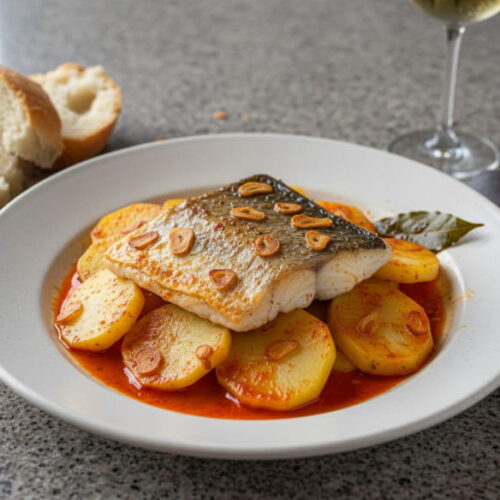
Merluza a la gallega
Cooking utensils
- 1 Large pot for the potatoes and fish
- 1 Small pan for the refrito
- 1 Ladle
- 1 Ovenproof serving dish or deep plate
Ingredients
FOR THE FISH:
- 600 g Hake fillet with skin, preferably fresh, cut into 4 pieces
- 1 Bay leaf
- 1 Garlic clove pressed on
- Salt
- 500 ml Water or light fish stock
FOR THE CACHELOS:
- 500 g Galician or floury potatoes
- Salt
FOR THE REFRITO:
- 5 Tbsp extra virgin olive oil
- 3 Garlic cloves cut into thin slices
- 1 teaspoon Pimentón de la Vera dulce Smoked sweet paprika
- ½ teaspoon pimentón de la vera picante smoked hot paprika
Preparation
PREPARATION:
- Wash the potatoes thoroughly in their skins.
- Check the hake fillet for bones and remove them.
- Thinly slice the garlic for the refrito.
COOKING STEPS:
- Place the potatoes in their skins in salted water and cook over a medium heat for approx. 20 minutes until they are soft – do not fall apart.
- In the meantime, heat the water or fish stock with the bay leaf and crushed garlic clove, season lightly with salt.
- Poach the hake fillets in simmering (not boiling) water for 8-10 minutes – the meat should be just cooked but still juicy.
- Drain the potatoes, leave to cool slightly, cut into 1 cm thick slices in their skins.
- For the refrito: Heat the olive oil in a small frying pan and fry the garlic slices over a medium heat until golden brown (do not let them burn).
- Briefly remove the pan from the heat, stir in the pimentón dolce and picante – pour immediately over the fish.
DIRECTIONS:
- Arrange the potato slices on the plates or a platter.
- Place the hake fillets on top, skin side up.
- Drizzle a little poaching liquid over the top.
- Prepare the refrito just before serving and pour immediately over the fish and potatoes while hot – it should sizzle.
- Serve immediately.
SUPPLEMENTS:
- Galician white bread to soak up the refrito oil
- Albariño Rías Baixas DO, well chilled (8-10 °C)
- No cheese, no cream – simplicity is the principle

