

The Apostle’s Cake—and the Wine That Was Waiting for Him
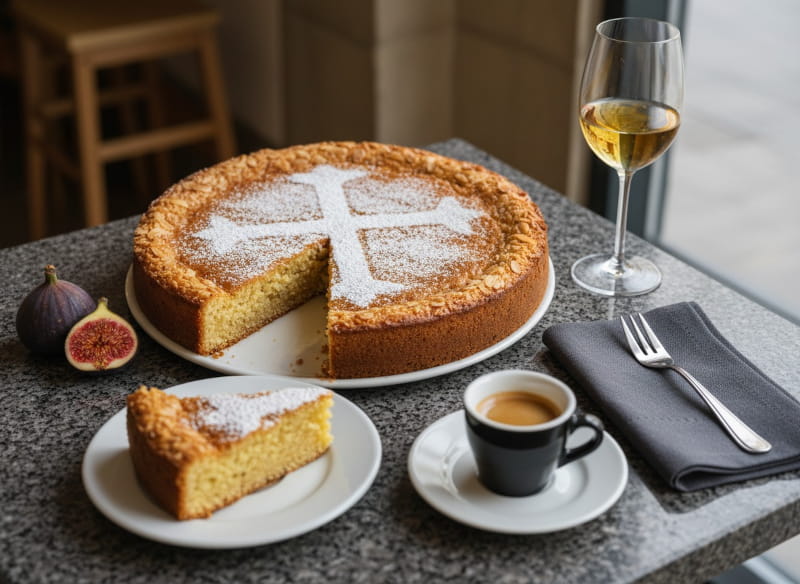
Pairing wine with food raises a question with this Galician dessert that all the other courses have left unanswered: What comes after the Albariño? The answer is: even more Albariño—but in its sweetest, ripest, and most contemplative form. The Tarta de Santiago is not an elaborate pastry. It is an almond cake that has been baked in Galicia since the Middle Ages, and whose only intricate detail is the powdered sugar stencil on the surface: the cross of St. James, the Cruz de Santiago, white on golden brown, the hallmark of a dish that needs no other hallmark.
The ingredients are simple: ground almonds, sugar, eggs, lemon zest, and a hint of cinnamon. No flour, no butter, no milk—the Tarta de Santiago is naturally gluten-free, a fact that hasn’t impressed anyone in Galicia for centuries, because that was never the intention. The ground almonds give it a texture that hovers between moist and crunchy: golden brown and slightly crispy on top, juicy and dense on the inside. The flavor is direct, sweet, and almondy, with a hint of citrus that lifts the sweetness. A dessert that needs no distraction—and a wine that meets it on equal footing in sweetness and character.
Ideal wine pairing: Albariño Rías Baixas DO Vendimia Tardía (Galicia, Spain)
Apricot, peach, candied citrus peel, jasmine blossom, honey, and a freshness that the wine retains despite its sweetness—the Albariño Vendimia Tardía, the late harvest of this Galician white wine, marks the conclusion of a journey through Galicia that began with the purest and simplest and ends with the sweetest. The Vendimia Tardía is made from overripe Albariño grapes that remain on the vine for weeks after the normal harvest date, concentrating sugar, retaining acidity, and developing aromas that the dry Albariño only hints at: riper, deeper, and more floral.
With the Tarta de Santiago, it unfolds alongside the almond notes. The ground almonds in the cake have a natural sweetness and a slight bitterness that lingers in the long finish—and the Albariño Vendimia Tardía carries precisely this nuance: Its apricot fruit mirrors the almond sweetness, its acidity prevents the pairing from becoming too heavy, and its jasmine-honey note gives the dessert a floral dimension that the cake itself does not possess but gratefully accepts. It is sweet enough to accompany the dessert, fresh enough not to overwhelm it. The end of the Galician journey tastes of honey, almonds, and Atlantic air. Producers such as Pazo de Señorans, Zárate, or Forjas del Salnés showcase the Vendimia Tardía in its most compelling form.
Further wine recommendations for this dish
Moscatel de Setúbal DOC (Setúbal, Portugal)
Orange blossom, candied apricot, dried fig, caramel, and an oxidative depth derived from the long barrel aging of the Moscatel—this Portuguese sweet wine from the Setúbal Peninsula south of Lisbon is the most harmonious non-Galician pairing for the Tarta de Santiago on this list. Its orange blossom aroma interacts with the lemon zest in the cake in a direct, Mediterranean way; its fig-caramel note extends the almond sweetness into a second dimension; and its freshness—unusual for a sweet wine—keeps the pairing lively. For anyone who likes to think Portuguese in their glass when enjoying Galician almond cake and discovers that the Iberian Peninsula takes its sweet wines no less seriously than its dry ones.
Sauternes AOC (Bordeaux, France)
Honey, beeswax, apricot jam, vanilla, and a botrytis complexity that no other sweet wine in the world expresses as clearly as a good Sauternes—for the Tarta de Santiago, it is the most luxurious and international pairing on this list. Its honey note mirrors the cake’s almond sweetness on a deep, rich level, its vanilla tone gives the pairing a baroque framework, and its botrytis spice provides an interesting contrast to the simple Galician honesty of the pastry. A Sauternes with Tarta de Santiago is not a regional choice—but it is a magnificent one.
Vin Santo del Chianti DOC (Tuscany, Italy)
Dried figs, almonds, honey, walnuts, and an oxidized flavor derived from years of aging in small barrels—Tuscan Vin Santo is the most traditional European accompaniment to almond pastries and shares a kinship with Tarta de Santiago that extends beyond the dessert itself. Both stem from a baking tradition that relies on a few, simple ingredients—almonds, sugar, eggs, dried fruit, and time. The Tuscan almond sweetness in Vin Santo and the Galician almond sweetness of the Tarta meet halfway and speak the same Mediterranean language.
Muscat de Beaumes-de-Venise AOC (Rhône, France)
Fresh rose petals, white peach, apricot, and a lightness that sets Muscat sweet wines apart from the heaviness of some dessert wines—the Muscat de Beaumes-de-Venise from the southern Rhône Valley is the most approachable and freshest sweet wine on this list for the Tarta de Santiago. Its floral aromas provide an airy, fragrant backdrop to the dense almond cake, its freshness prevents it from feeling heavy, and its white peach notes interact with the lemon zest in the cake in an aromatic way you wouldn’t expect from a sweet wine. For anyone who doesn’t want a heavy sweet wine with dessert, but rather a floral, light one—that’s still sweet enough.
Albariño Rías Baixas DO (Galicia, Spain)
This dry, classic Albariño serves as a counterpoint to the Vendimia Tardía—for those who prefer not to pair Galician almond cake with a sweet wine, but instead seek a contrast. Its citrus freshness and lively acidity provide a cool, invigorating counterpoint to the sweetness and richness of the tart, and its Atlantic character remains present throughout the pairing as a reminder of where this dessert comes from. It’s not a classic dessert pairing—but it’s the most Galician one, and sometimes that’s enough.
All other recipes and wine recommendations from Galicia can be found in the Galicia wine region category.
The recipe:

Santiago Cake
Cooking utensils
- 1 Springform pan (24–26 cm in diameter)
- 1 Hand mixer or stand mixer
- 1 Santiago Cross template (cut out of paper or purchase)
- Baking paper
- 1 Sieve for powdered sugar
Ingredients
FOR THE CAKE:
- 250 g ground almonds blanched
- 250 g Sugar
- 4 Eggs Size M, room temperature
- Zest of 1 untreated lemon
- Zest from ½ untreated orange
- 1 1 tsp ground cinnamon
- 1 Pinch of salt
- Butter and flour for the pan
FOR DECORATION:
- 2 –3 tbsp powdered sugar
- Cruz de Santiago stencil cut out of parchment paper
Preparation
PREPARATION:
- Preheat the oven to 180 °C top/bottom heat.
- Grease a springform pan and dust it lightly with flour, or line it with parchment paper.
- Cut out a Cruz de Santiago stencil from parchment paper.
COOKING STEPS:
- In a bowl, beat the eggs and sugar with an electric mixer for 3–4 minutes until light and creamy.
- Stir in the ground almonds, lemon zest, orange zest, cinnamon, and salt—just briefly, until everything is combined.
- Pour the batter into the prepared pan and smooth the top.
- Bake in a preheated oven for 30–35 minutes until golden brown—a wooden skewer should come out clean.
- Let the cake cool completely in the pan.
DIRECTIONS:
- Remove the cooled cake from the pan and place it on a cake plate.
- Place the Santiago cross stencil in the center of the cake.
- Sift the powdered sugar evenly over the stencil.
- Carefully lift off the stencil—the white cross will remain on the golden-brown cake.
- Serve immediately or store at room temperature for up to three days—it gets better with time.
SUPPLEMENTS:
- Espresso or café con leche
- Crème fraîche or lightly sweetened whipped cream
- Fresh figs or raspberries (in season)

