

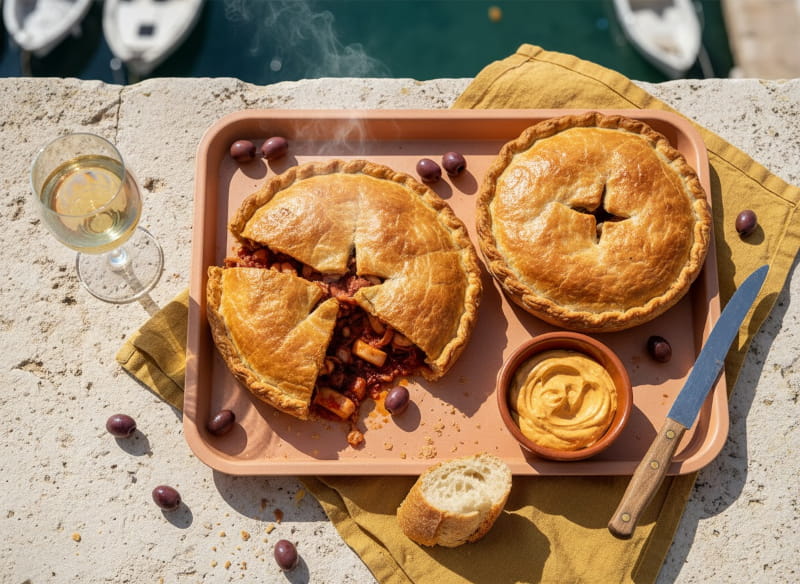
The squid pie from Sète—and the wine that comes from the same lake
When it comes to pairing wine with food, the Tielle sétoise is a dish that most travelers to Sète recognize as the city’s most distinctive local specialty: in the city’s bakeries and épiceries, wrapped in cellophane or still warm from the oven, a small, round pie with a deep red, spicy squid filling that oozes through the golden-brown crust. The tielle is not a gourmet dish, nor does it claim to be—it is the dish that sets Sète apart from all other cities in the Languedoc and that appears in no other cuisine in the world in this form.
Sète itself is a unique phenomenon in the Languedoc: a city on a peninsula, built between the Étang de Thau and the Mediterranean Sea, crisscrossed by canals, with a fishing heritage that has been preserved through centuries of port work and seafood harvesting. The tielle arrived in the city in the early twentieth century with Italian immigrants—more specifically, with Adriatic fishermen from Gaeta in Campania, who landed in Sète and brought their tradition of stuffed squid with them. What began as tiellèdde (the original Campanian tielle) became, in Sète, a distinct dish of the Occitan coast, featuring Piment d’Espelette instead of peperoncino, with Languedoc tomato sauce instead of Campania sugo, and with a shortcrust pastry that takes on a different character from the olive oil of the south than from the butter of the north.
Ideal wine pairing: Picpoul de Pinet AOC (Languedoc, France)
Lemon, green apple, a hint of almond, pronounced acidity, and a briny freshness from the vineyards along the shores of the Étang de Thau —the Picpoul de Pinet is both the most obvious and the most compelling choice for the Tielle sétoise, because it comes from the same lake ecosystem as the squid that fills the Tielle. The Tielle is a rich dish: olive oil in the dough, olive oil in the filling, and a seasoned tomato-squid mixture that is rich and intense. The Picpoul cuts through this richness with a directness that no heavier wine could achieve—its pronounced acidity acts as a palate cleanser after every bite, and its citrus note provides a bright, clear contrast to the spicy tomato base, and its light body keeps the pairing light and approachable, even though the dish itself is rich.
It’s a pairing that needs no explanation in Sète: You buy the tielle at the bakery, pick up the Picpoul from the winemaker by the Étang, and enjoy one with the other, because both are local. The concept of terroir is rarely experienced as directly as at the tables of Sète, where the dish and the wine share the same coastal lake as their origin. Producers such as Domaine Félines Jourdan, Château Gaujal de Saint Bon, and Domaine du Tariquet showcase Picpoul in its most complete form for this pairing.
Further wine recommendations for this dish
Vermentino di Sardegna DOC (Sardinia, Italy)
Citrus, almond, a slightly bitter finish, and a briny quality from Sardinia’s granite coastal vineyards—Vermentino di Sardegna is the most compelling Mediterranean alternative to Picpoul for Tielle sétoise. Both come from coastal regions with granite soils and proximity to the sea; both carry the salt of the coast within them; both have a bitterness on the finish that makes them easy to pair with spicy, fatty dishes. The Campanian roots of the tielle blend with the Sardinian origins of Vermentino on an Italian-Mediterranean foundation: olive oil, squid, and the Mediterranean breeze. For anyone who likes to think Sardinian when enjoying the Occitan tielle.
Faugères AOC White (Languedoc, France)
The full-bodied Languedoc white wine on this list—Grenache Blanc, Roussanne, and Marsanne grown on slate, with notes of pear, almond, herbs, and a waxy, full-bodied texture—is the most harmonious regional alternative to Picpoul for a Tielle sétoise that’s particularly spicy and rich. Its richness holds its own against the olive oil and squid mixture without overpowering it; its herbal spice resonates with the Piment d’Espelette in the filling; and its slate-driven minerality provides the pairing with a structured, serious framework. For evenings when the tielle is not a snack but a main course—and the wine can have the substance to match.
Grillo Sicilia DOC (Sicily, Italy)
White peach, citrus blossom, almond, and a Mediterranean warmth that the Grillo brings from the sun-drenched coast of western Sicily—for the Tielle sétoise, an Italian-insular pairing that captivates with its aromatic profile. The tielle has its roots in Campanian cuisine and was influenced by Sicilian and Genoese fishermen who landed in Sète; the Grillo, as a Sicilian wine, restores an Italian-Mediterranean dimension to the dish that is historically authentic. Its white, peachy fruit provides an aromatic contrast to the tomato and squid filling; its moderate acidity complements the olive oil in the dough; and its Mediterranean warmth bathes the pairing in the sunlight that is so characteristic of Sète.
Côtes de Gascogne IGP White (Southwest France)
Fresh, aromatic, with notes of grapefruit, white peach, and a lively acidity contributed by the Ugni Blanc and Colombard grapes from the vineyards of Gascony—the Côtes de Gascogne IGP Blanc is the most approachable and affordable pairing for the Tielle sétoise on this list. Its pronounced fruit aromas provide a fresh, southwestern French contrast to the spicy squid filling, and its acidity complements the olive oil in the dough with a directness reminiscent of Picpoul, without making the same regional claims. For anyone who chooses an everyday wine to pair with an everyday meal and discovers that Gascony understands the Languedoc.
Picpoul de Pinet AOC Perlant (Languedoc, France)
A lightly sparkling Picpoul—produced by some winemakers as a natural wine with minimal residual carbonation—represents the “playfulness” element on this list for the Tielle sétoise. The subtle effervescence complements the richness of the shortcrust pastry, creating a lightness on the palate that balances out the richness of the filling: fresher, livelier, and less serious than a still Picpoul. Rare and not available at every wine shop, but for an evening in Sète with a tielle and a willingness to explore, it’s the most surprising option on the list.
You can find all other recipes and wine recommendations from the Languedoc in the ” Languedoc Wine Region” category.
The recipe:
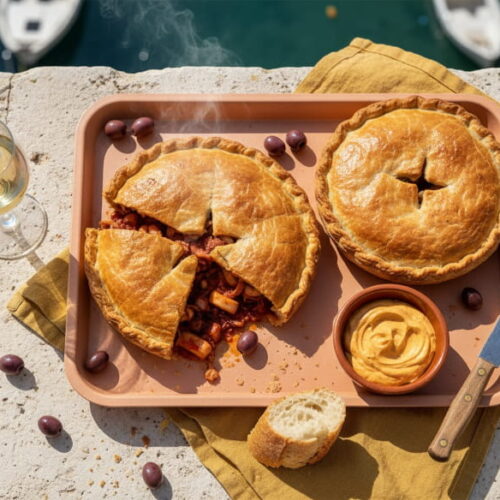
Tielle sétoise
Cooking utensils
- 1 Round baking pan (24 cm Ø) or several small pans (12 cm Ø)
- 1 Pan for the filling
- 1 Rolling pin
- Baking paper
Ingredients
FOR THE DOUGH:
- 300 g Wheat flour Type 550
- 80 ml extra virgin olive oil
- 80 ml Water lukewarm
- 1 teaspoon salt
- 1 teaspoon white wine vinegar
FOR THE FILLING:
- 600 g Squid cleaned, cut into small pieces; alternatively: calamari rings
- 400 g chopped tomatoes Canned or fresh, pitted
- 1 medium-sized onion finely chopped
- 3 Garlic cloves chopped
- 2 EL black olives cored and chopped
- 1 tablespoon tomato paste
- 1 TL Piment d’Espelette or mild chili powder
- 1 TL Sweet Paprika sweet bell pepper
- 2 Tbsp extra virgin olive oil
- Salt black pepper
- 1 Egg yolk for brushing
Preparation
PREPARATION:
- To make the dough, knead the flour, salt, olive oil, vinegar, and lukewarm water into a smooth, non-sticky dough.
- Divide into two portions (⅔ for the base, ⅓ for the top), wrap in plastic wrap, and let rest for 30 minutes.
- Preheat the oven to 200 °C top/bottom heat.
COOKING STEPS:
- Heat the olive oil in a pan; sauté the onion and garlic over medium heat for 5 minutes.
- Add the squid pieces and sauté for 3–4 minutes.
- Add the tomatoes, tomato paste, olives, Piment d’Espelette, and bell peppers.
- Simmer over medium heat for 20–25 minutes until the filling thickens and there is hardly any liquid left.
- Season with salt and pepper to taste, then let cool completely.
DIRECTIONS:
- Roll out the large piece of dough (⅔) into a circle on a floured surface, place it in the buttered pan, and pull the edges up.
- Spread the filling evenly.
- Roll out a small piece of dough, place it on top as a lid, and press it firmly against the bottom.
- Press down the edges with a fork and prick the surface several times.
- Brush with egg yolk.
- Bake at 200 °C for 30–35 minutes until golden brown.
- Let it cool for 10 minutes—it’s just as good hot or lukewarm.
SUPPLEMENTS:
- Green salad with lemon vinaigrette
- Rouille or aioli as a dip
- Fresh baguette

