

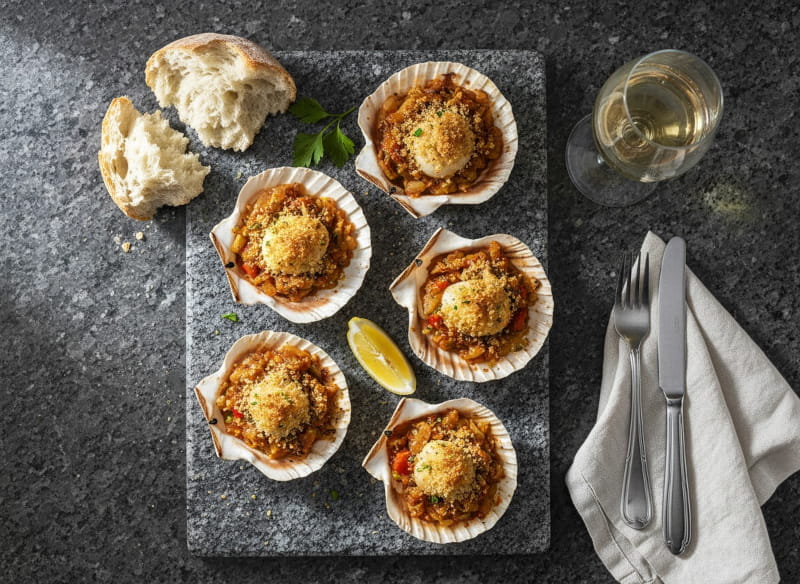
The scallop as a pilgrim’s dish – and the wine that went the same way
The combination of wine and food in the Vieiras a la gallega achieves a moment that goes beyond the culinary. The scallop shell – vieira in Galician, pecten maximus in Latin – has been the symbol of the Camino de Santiago since the Middle Ages. Pilgrims wore them on their hats and cloaks as a sign of their completed journey. For generations, the Rías Baixas have supplied the markets of Santiago de Compostela with the meatiest and sweetest scallops in Europe – grown in the cold, nutrient-rich Atlantic waters of the bays, where the tide washes in fresh plankton twice a day.
The recipe is Galician in its most direct form: The mussel is stuffed in its domed shell with a sofrito of slow-braised onions, tomatoes, green peppers and a dash of white wine, sprinkled with breadcrumbs and gratinated in the oven until golden brown. No cheese. No cream. No compromises that would complicate the mussel pairing. The result is a dish that is sweet, salty, spicy and light all at the same time – and that calls for an Albariño from O Rosal, which is fuller-bodied and fruitier than its brother from Val do Salnés.
Ideal wine pairing: Albariño Rías Baixas DO – O Rosal (Galicia, Spain)
White peach, apricot, tangerine zest, jasmine and a subtle richness that surpasses the Val-do-Salnés Albariño in body – the Albariño from O Rosal, the southernmost subzone of the Rías Baixas near the Portuguese border, is a different wine to the sea-salt distillate of the northern heartland. The climate here is milder, the rías wider and the granite and clay soils give the Albariño a round, melting texture that would be a touch too much for direct seafood such as percebes or oysters served raw – but just right for the gratinated vieiras a la gallega with their sofrito foundation.
With the Vieiras a la gallega, it unfolds through the parallel of sweetness and fruit. The sofrito – made from onions, tomatoes and green peppers that almost caramelize in olive oil at the lowest heat – has a gentle vegetable sweetness that the Albariño from O Rosal mirrors and extends with its ripe peach and mandarin notes. At the same time, its acidity cuts through the breadcrumb crust, giving each bite a freshness that makes the dish lighter than it is. Its mandarin zest responds to the scallops themselves – the Vieira’s white, sweet muscle meat has a natural fruitiness that the wine picks up on and carries into the long finish. Wineries such as Terras Gauda, Lagar de Fornelos and Castro Martin bring out the O-Rosal character in its most convincing form.
Further wine recommendations for this dish
Albariño Rías Baixas DO – Val do Salnés (Galicia, Spain)
The more classic, more saline Albariño from the heartland of the Rías Baixas – and the more coherent choice for a version of Vieiras that emphasizes less sofrito and more pure seafood flavor. Its marine notes communicate more directly with the shellfish flavor, its acidity is more lively than that of O Rosal, and its slenderness gives the Vieiras an elegant, unencumbered accompaniment. Those who prepare Vieiras a la gallega as a light summer dish without too much sofrito will be better served with the Val-do-Salnés Albariño than with its fuller-bodied O Rosal brother.
Godello Valdeorras DO (Galicia, Spain)
The fullest-bodied Galician white wine – and for a version of Vieiras that is particularly richly gratinated, the more harmonious alternative to Albariño. Pear, quince, white flowers and a slate minerality from the Valdeorras slopes give the Godello a richness and depth that it carries elegantly in the glass without appearing heavy. Its structure stands up to the richer sofrito of the Vieiras, and its minerality provides an interesting contrast to the sweetness of the mussel flavor. For all those who like to play off the second Galician white wine ace, which hardly anyone knows, with their scallop dish.
Chablis Premier Cru AOC (Burgundy, France)
Crystal-clear minerality, cool citrus fruit, a hint of iodine from the chalk base and a finish reminiscent of fossilized sea shells – because that is exactly what the Kimmeridgian limestone on which the Chablis Premier Crus stand: compressed mussel shells from the Jurassic Sea. With the Vieiras a la gallega, the Chablis Premier Cru meets seafood from the Atlantic and builds a bridge from Burgundian chalkstone to Galician granite. Its coolness gives the gratinated vieiras an elegant frame, while its long finish makes every sip a moment in its own right.
Soave Classico DOC (Veneto, Italy)
White almond, lemon zest, fresh herbs and a subtle minerality from the basalt and tuff soil of the Classico zone around Soave – the Soave Classico from the Garganega grape is one of Italy’s most underrated white wines and a surprisingly harmonious accompaniment to vieiras a la gallega. Its almond notes mirror the toasted breadcrumbs of the gratin crust, its herbal spiciness responds to the sofrito, and its fresh, medium acidity gives the mussels an elegant frame without overpowering them. For all those who like to think of northern Italian mussels in a glass.
Grüner Veltliner Wachau DAC (Wachau, Austria)
White pepper, grapefruit, citrus fruit and a lively acidity from the loess and primary rock soils of the Wachau – the Grüner Veltliner from the Danube Gorge is the Austrian guest entry on this list and a companion for the Vieiras a la gallega that surprises with its peppery spiciness. Its characteristic peppery note provides a spicy contrast to the sweet sofrito and the sweet mussel meat, its acidity gives the dish freshness and its medium body is big enough to accompany the gratin crust. For all those who like to drink a white wine with a distinct character of its own with scallops.
All other recipes and wine recommendations from Galicia can be found in the Galicia wine region category.
The recipe:
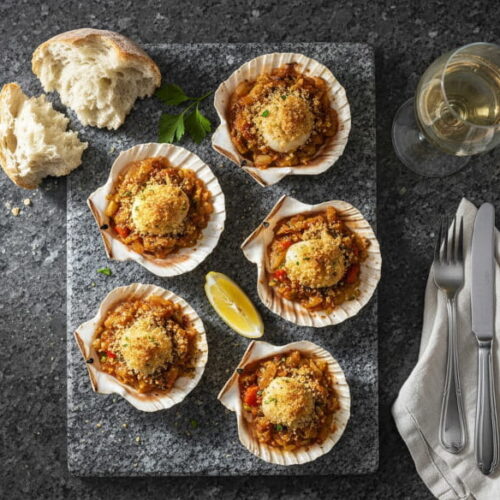
Vieiras a la gallega
Cooking utensils
- 1 Ovenproof baking dish or baking tray
- 1 Large pan for the sofrito
- 1 Kitchen knife and chopping board
- 1 Spoon for filling
Ingredients
FOR THE VIEIRAS:
- 6 fresh scallops in the shell or 6 mussels + 6 domed shells
- Salt black pepper
FOR THE SOFRITO:
- 2 medium-sized onions very finely diced
- 1 green bell pepper very finely diced
- 2 ripe tomatoes skinned and diced (or 150 g strained tomatoes)
- 3 Tbsp extra virgin olive oil
- 1 Garlic clove finely chopped
- 50 ml dry white wine Albariño
- 1 teaspoon Pimentón de la Vera dulce
- Salt black pepper
- 1 A pinch of sugar
FOR THE GRATIN CRUST:
- 40 g stale white bread finely grated
- 1 Tbsp extra virgin olive oil
- 1 tablespoon fresh parsley finely chopped
Preparation
PREPARATION:
- Open the scallops, carefully remove the muscle meat and the roe.
- Rinse the mussel meat in cold water and pat dry. Pick up the curved shells and clean thoroughly.
- Preheat the oven to 200 °C top/bottom heat, switch on the grill for the last few minutes.
- Mix the breadcrumbs with the olive oil and parsley.
COOKING STEPS:
- Heat the olive oil in a pan.
- Slowly braise the onions and green peppers over a low heat for 20 minutes until golden brown – do not fry, just let them melt.
- Briefly sauté the garlic.
- Deglaze with white wine and reduce completely.
- Add the tomatoes and pimentón and cook for a further 10 minutes until the sofrito is creamy.
- Season to taste with salt, pepper and a pinch of sugar.
- Season the mussel meat with salt and pepper.
DIRECTIONS:
- Place one bowl on each baking tray.
- Pour the Sofrito evenly into the bowls.
- Place one mussel meat and the roe (if available) on top.
- Sprinkle generously with the breadcrumb mixture.
- Bake in the oven for 8 minutes, then briefly gratinate under the grill until golden brown (2-3 minutes).
- Serve immediately – directly in the bowl.
SUPPLEMENTS:
- Crispy Galician white bread
- Albariño Rías Baixas DO O Rosal, well chilled (8-10 °C)
- Lemon wedge optional

