


Spring meets Alsace: when wild garlic, asparagus and goat’s cheese come together on the tarte flambée
Combining wine and food in this dish starts with an unusual question: which wine goes well with a tarte flambée that has spring itself on it? Green asparagus, aromatic wild garlic cream and tangy goat’s cheese on a thinly rolled out pastry baked in a hot oven until crispy – a combination that unites Alsatian culinary philosophy with German spring ingredients. The tarte flambée brings a roasted aroma and crispiness, the wild garlic cream an intense, slightly pungent plant aroma, the goat’s cheese a creamy spiciness and the asparagus a fresh bitterness. This requires a wine that is light but has character. A Müller-Thurgau from Franconia is the charming surprise here.
Ideal wine accompaniment: Müller-Thurgau Kabinett dry (Franconia, Germany)
Floral, gentle and with an accessibility that you don’t always expect from Franconian wines: Müller-Thurgau – a cross between Riesling and Madeleine Royale – is considered a simple everyday grape variety, but from Franconia, vinified dry and at Kabinett level, it shows its best face. White flowers, nutmeg, ripe apple and a subtle herbal spiciness characterize the aroma. The acidity is moderate and inviting, the body light – exactly what a tarte flambée needs: not a wine that drowns it out, but one that plays along. The wild garlic cream finds a congenial partner in the herbal notes of the Müller-Thurgau, while the goat’s cheese is enlivened by the wine’s subtle acidity. A glass that you forget to put down because it is so uncomplicated and yet so harmonious.
Further wine recommendations for this dish
Grüner Veltliner Federspiel DAC (Wachau, Austria)
Peppery, light and with a freshness that captures spring in a glass: The Federspiel from the Wachau is the most classic accompaniment for light summer dishes and rustic pasta. The white pepper in the finish finds the spicy wild garlic cream, the herbal notes reflect the green asparagus, the fresh acidity keeps the creamy goat’s cheese in balance. Light-footed, precise and never boring – a Federspiel for a tarte flambée is a combination that you have made once and will want to make again and again.
Silvaner QbA dry (Franconia, Germany)
Earthy, herbal and with a minerality that immediately whets the appetite: the simple Silvaner QbA from Franconia is the more accessible, lighter version of Silvaner and an ideal everyday companion for tarte flambée and quiches. The aromas are subtle – quince, celery, fresh herbs, a hint of stone – and blend in in such a way that the dish remains in the foreground. The wild garlic cream does not compete with the herbal notes of the Silvaner, but complements them. For all those who want to keep the Franconian character in the glass with their tarte flambée, but are looking for something lighter than the Kabinett.
Crémant d’Alsace AOC Brut (Alsace, France)
Sparkling, fresh and with a fine perlage that turns every tarte flambée evening into a small celebration: Crémant d’Alsace, made from Pinot Blanc, Auxerrois or Riesling, is the great sparkling wine of Alsace and the most natural accompaniment to tarte flambée, which, after all, comes from this region. The carbonic acid cuts through the creaminess of the goat’s cheese and wild garlic cream, the freshness invigorates the palate between every bite. If you want to set the mood with an asparagus tarte flambée, open the crémant.
Riesling Kabinett dry (Palatinate, Germany)
Citrusy, floral and with a directness that perfectly sets off the green asparagus on the tarte flambée: The Pfälzer Riesling Kabinett trocken is lighter than a Spätlese, but with the same precision. Citrus zest, white peach and a fine minerality characterize the picture. It offers a pleasant contrast to the wild garlic cream – freshness against spice – which invigorates the palate and keeps it curious. The goat’s cheese finds its best friend in the acidity of the Riesling. Ideal for anyone who wants to make the most of the Palatinate’s home advantage when it comes to tarte flambée.
Rosé de Provence AOC (Provence, France)
Light pink, dry and with a freshness that immediately suggests a terrace and sunshine: A classic dry Provence rosé made from Grenache, Cinsault and Mourvèdre brings red berries, fresh herbs from the garrigue and a lively acidity that approaches the tarte flambée from a different direction. Not the mineral-herbal line of the white wine, but a fruity, Mediterranean freshness. Provence rosé is a classic combination with goat’s cheese – Provence loves its goat’s cheese and its rosé in equal measure. If you want to add a splash of color to your spring tarte flambée, go for the pink bottle.
You can find more inspiration for asparagus and the right wine in the asparagus and wine category.
The recipe:
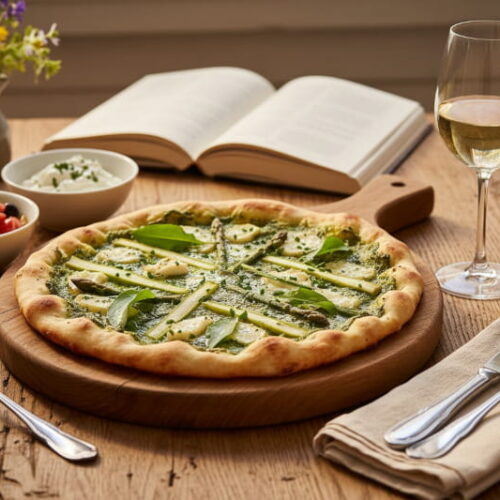
Green asparagus on tarte flambée with wild garlic cream and goat’s cheese
Cooking utensils
- 1 Baking stone or baking tray (preferably preheated)
- 1 Rolling pin
- 1 Mixing bowl (for the wild garlic cream)
- 1 Hand blender or food processor
- 1 Knife and chopping board
- Baking paper
- 1 Pan for the asparagus
Ingredients
TARTE FLAMBÉE DOUGH:
- 200 g Flour Type 550
- 100 ml Lukewarm water
- 2 1 tbsp olive oil
- 1 Pinch of salt
- BÄRLAUCHCREME:
- 1 bunch of fresh wild garlic approx. 50 g
- 150 g Crème fraîche
- 50 g cream cheese
- Salt white pepper
- 1 1 tsp lemon juice
PLAIN:
- 200 g green asparagus woody ends removed
- 100 g Goat’s cheese roll in slices
- 1 1 tbsp olive oil
- Salt black pepper
GARNITURE:
- Fresh wild garlic or chives
- Some high-quality olive oil for drizzling
- Fleur de Sel
Preparation
PREPARATION (DOUGH):
- Knead the flour, salt, water and olive oil into a smooth dough.
- Wrap the dough in cling film and leave to rest for 15 minutes.
- Preheat the oven to 250 °C (top/bottom heat) – preferably with a baking stone.
PREPARATION (WILD GARLIC CREAM):
- Wash, dry and roughly chop the wild garlic.
- Finely puree the wild garlic, crème fraîche, cream cheese and lemon juice with a hand blender.
- Season to taste with salt and pepper and chill.
PREPARATION (ASPARAGUS):
- Wash the green asparagus and break off the woody ends.
- Fry in a pan with olive oil for 3-4 minutes over a high heat.
- Season with salt and pepper – the asparagus should still be firm to the bite.
COOKING STEPS:
- Roll out the dough very thinly on a floured surface (as thin as possible).
- Place on baking paper.
- Spread the wild garlic cream evenly and thinly over the pastry – right up to the edge.
- Spread the asparagus spears over the cream.
- Place slices of goat’s cheese in between.
- Drizzle with a little olive oil and season with pepper.
- Bake the tarte flambée on the hot baking stone or tray for 10-12 minutes until the edges are crispy and golden brown.
DIRECTIONS:
- Remove the tarte flambée from the oven and immediately sprinkle with fresh wild garlic or chives.
- Finish with a drizzle of olive oil and fleur de sel.
- Serve immediately – the tarte flambée waits for no one.
SUPPLEMENTS:
- Mixed spring salad with walnut vinaigrette
- Tomato and olive salad with basil
- Crème fraîche with fresh herbs

