

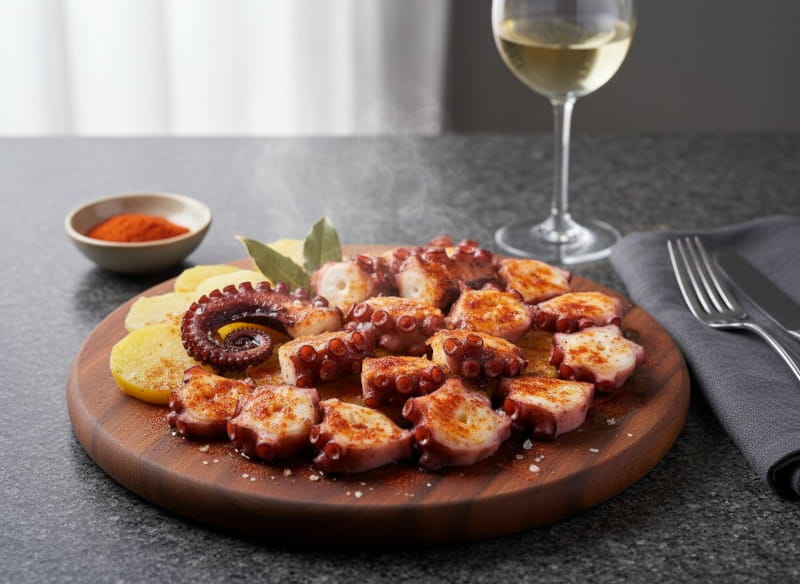
The most honest dish in Galicia – and the wine that tastes of the sea
Combining wine and food starts with a lesson in reduction with Pulpo a Feira. No dish in Galician cuisine is simpler, and no dish in Galician cuisine is more difficult to perfect. A Galician octopus – fresh from the rías, the Atlantic bays that cut deep into the land – is cooked in a copper pot of bubbling boiling water, briefly immersed three times to prevent the meat from tearing, then completely submerged and left to simmer gently for a good hour. The result is cut with scissors onto a wooden board (the tábua), dusted with pimentón de la vera – smoked paprika that gives the dish its reddish-brown color and spicy undertone – sprinkled with coarse sea salt and drizzled with Galician olive oil. Done.
The pulpeiras – the women who have been cooking pulpo at Galician ferias (markets) for generations – have no recipes. They have experience. They know when the octopus is ready: when a toothpick penetrates the arm without resistance. When the flesh is white and the skin purple-red and the tentacles soft. Anyone who has eaten pulpo a feira at a pulpeira in a marketplace in Galicia will understand why this dish is exported but can never be fully reproduced. And they will understand why Albariño from the Val do Salnés is the only wine that competes on the same elemental level.
Ideal wine pairing: Albariño Rías Baixas DO – Val do Salnés (Galicia, Spain)
Lemon, white peach, apricot, grapefruit, jasmine and underneath a salinity that does not come from a laboratory, but from the granite soils and the Atlantic wind of the Val do Salnés – the Albariño from this subzone, the heartland of the Rías Baixas directly on the coast, is the white wine closest to the sea in Spain and one of the closest to the sea in Europe. The vines grow less than five kilometers from the Atlantic Ocean, on the same granite pillars of the Parrales where the ancestors of today’s winegrowers grew grapes in the Middle Ages. The granite gives the soil a dry minerality that absorbs the rainwater – abundant, Atlantic, cold – but does not hold it. What the vine drinks, you can taste in the glass.
With the Pulpo a Feira, it unfolds through an aromatic trinity. The salinity of the wine mirrors the seawater in which the octopus was cooked on a direct, almost physical level – not a contrived pairing, but a fact of the terroir. Its citrus freshness cuts through the olive oil that coats the pulpo brilliantly after plating, keeping the palate vibrant and clear after each bite. And its citrus fruit provides a bright, fresh contrast to the smoked pimentón de la vera that sits atop the tentacles – the sweet and spicy of the bell pepper is not enhanced by the wine, but framed and thus made complete. The best expressions come from Pazo de Señorans, Do Ferreiro or Palacio de Fefiñanes – wineries that capture the Val-do-Salnés character in its purest form.
Further wine recommendations for this dish
Muscadet Sèvre et Maine sur Lie AOC (Loire, France)
The classic European oyster wine – and for the Pulpo a Feira a companion that surprises with its reduction. The long maturation on the fine lees (sur lie) gives the Muscadet a bread-like depth and a creaminess that you would not expect from such a light, dry white wine. It works with the pulpo in a restrained manner: Its salinity communicates with the sea flavor of the octopus, its acidity enlivens the olive oil, and its leanness never interferes with the dish. For those who want a European white wine in their glass with pulpo a feira that does not come from Galicia but carries the same Atlantic DNA, Muscadet sur Lie is the most coherent and down-to-earth choice.
Txakoli DO Getariako Txakolina (Basque Country, Spain)
The wine brother of the Albariño from the Basque Country – slightly sparkling, highly acidic, extremely dry and with a salinity that comes closest to the Val-do-Salnés Albariño in its Atlantic directness. Txakoli is made in Getaria, Zarautz and Aia on the Basque coast from the Hondarrabi Zuri grape and is traditionally poured into the glass from a great height to allow the carbon dioxide to develop. With Pulpo a Feira, this perlage does the same as with Muscadet: it cuts through the fat of the olive oil after every bite and sets the palate back. If you like to drink a Spanish wine from outside Galicia with your pulpo without abandoning its Atlantic origins, choose Txakoli.
Assyrtiko Santorini PDO (Aegean, Greece)
Volcanic, bone-dry, with an electrifying acidity and a salinity that comes from the pumice soil of the Aegean island of Santorini – the Assyrtiko is the Albariño of the eastern Mediterranean, and with the Pulpo a Feira it meets a dish that speaks the same language: sea, salt, minerality, no excess. Its acidity is more intense than that of the Albariño, its finish longer, its minerality more rugged – it is not a flattering wine, but a precise one. For those who want contrast and character in their glass of Pulpo a Feira rather than harmony, Assyrtiko is the most exciting non-Galician choice on this list.
Vermentino di Sardegna DOC (Sardinia, Italy)
Citrus-fresh, almondy, with a characteristic bitter note on the finish and a salinity from the Sardinian sea – Vermentino di Sardegna is Italy’s most accessible seafood white wine and a companion for the Pulpo a Feira, which impresses with its accessibility. Its bitterness on the finish is the key feature: it provides a dry, awakening contrast to the smoked spiciness of the pimentón and the oiliness of the olive oil. For evenings when pulpo is the starter before a larger Galician menu, Vermentino di Sardegna is the most drinkable and uncomplicated companion on this list.
Chablis AOC (Burgundy, France)
Chalk stone, cool citrus fruit, a hint of iodine and a finish of mineral coolness – Chablis is the international reference for seafood white wine and with Pulpo a Feira, it proves that the reputation is well deserved. Its terroir – the Kimmeridgian chalk of the Chablisier hills, composed of fossilized marine shells – gives the wine a fossil sea minerality that communicates with the Atlantic octopus in a quiet, intellectual way. Its bony body and dry precision give the Pimentón Olive Oil Pulpo an elegant frame. As a premier cru – Montée de Tonnerre, Fourchaume or Vaillons – it is the most prestigious and rewarding non-Galician companion for a festive pulpo dinner.
All other recipes and wine recommendations from Galicia can be found in the Galicia wine region category.
The recipe:
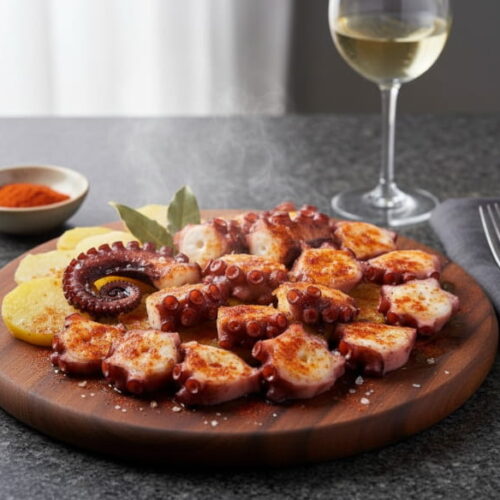
Pulpo a Feira
Cooking utensils
- 1 Großer Topf (mind. 8 Liter) oder Kupferkessel
- 1 Kitchen scissors
- 1 Holzbrett (Tábua) zum Servieren
- 1 Optional kitchen thermometer
- 1 Ladle
Ingredients
FOR THE PULPO:
- 1 Galician octopus approx. 1.5 kg (deep-frozen – freezing makes the meat tender)
- 1 Bay leaf
- 1 Tbsp coarse sea salt for the cooking water
FOR THE CACHELOS:
- 600 g Galician potatoes floury, e.g. Kennebec
- Salt
TO DIRECT:
- Pimentón de la Vera dulce Smoked sweet paprika
- Pimentón de la Vera picante smoked hot paprika – to taste
- Coarse sea salt Flor de Sal if possible
- 4 Tbsp extra virgin olive oil Galician or Spanish
Preparation
PREPARATION:
- Defrost the octopus overnight in the refrigerator – freezing replaces the traditional pounding and makes the muscle fibers tender.
- Thoroughly brush the potatoes in their skins.
- Bring the cooking water to the boil in a large pan, add the bay leaf and salt.
COOKING STEPS:
- Hold the octopus by the head and dip it briefly into the boiling water three times and remove it again (3 seconds each time) – the “susto” (shock) prevents the skin from tearing open.
- Insert completely on the fourth immersion.
- Reduce the heat so that the water simmers gently – no longer boiling.
- Cook for approx. 45-50 minutes until a toothpick slides into the thickest tentacle arm without resistance.
- Remove the pan from the heat and leave the octopus to rest in the water for another 10 minutes.
- Boil the potatoes in separate salted water or in the octopus cooking water in their skins until soft (approx. 20 minutes), drain, peel and cut into 1 cm thick slices.
DIRECTIONS:
- Cut the octopus into bite-sized slices with scissors – directly on the wooden board.
- Arrange the potato slices around or under the pulpo.
- Dust generously with pimentón dulce and add a little pimentón picante if desired.
- Sprinkle coarse sea salt over everything.
- Pour over the olive oil immediately before serving.
- Serve immediately – Pulpo a Feira is eaten warm.
SUPPLEMENTS:
- Cachelos (potatoes in skin) – always included
- Galician or good Spanish white bread to soak up the oil
- Albariño Rías Baixas DO, well chilled (8-10 °C)

